- English
- French
- German
- Portuguese
- Spanish
- Russian
- Japanese
- Korean
- Arabic
- Greek
- German
- Turkish
- Italian
- Danish
- Romanian
- Indonesian
- Czech
- Afrikaans
- Swedish
- Polish
- Basque
- Catalan
- Esperanto
- Hindi
- Lao
- Albanian
- Amharic
- Armenian
- Azerbaijani
- Belarusian
- Bengali
- Bosnian
- Bulgarian
- Cebuano
- Chichewa
- Corsican
- Croatian
- Dutch
- Estonian
- Filipino
- Finnish
- Frisian
- Galician
- Georgian
- Gujarati
- Haitian
- Hausa
- Hawaiian
- Hebrew
- Hmong
- Hungarian
- Icelandic
- Igbo
- Javanese
- Kannada
- Kazakh
- Khmer
- Kurdish
- Kyrgyz
- Latin
- Latvian
- Lithuanian
- Luxembou..
- Macedonian
- Malagasy
- Malay
- Malayalam
- Maltese
- Maori
- Marathi
- Mongolian
- Burmese
- Nepali
- Norwegian
- Pashto
- Persian
- Punjabi
- Serbian
- Sesotho
- Sinhala
- Slovak
- Slovenian
- Somali
- Samoan
- Scots Gaelic
- Shona
- Sindhi
- Sundanese
- Swahili
- Tajik
- Tamil
- Telugu
- Thai
- Ukrainian
- Urdu
- Uzbek
- Vietnamese
- Welsh
- Xhosa
- Yiddish
- Yoruba
- Zulu
What Is a Foldable platform hand truck trolley? Explained
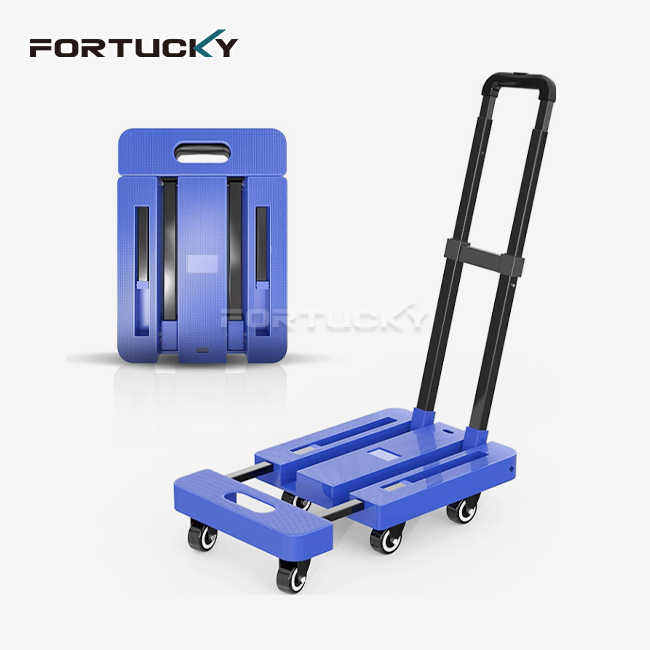
A foldable platform hand-truck trolley is a versatile material handling tool featuring a flat loading deck supported by a folding handle and wheels. Its defining characteristic is the handle, which folds flat against the base when not in use. This simple design makes it easy to store in crowded warehouses, delivery vans, or maintenance rooms. These trolleys are typically constructed from tubular steel frames with platforms made of plywood, aluminum, or reinforced polypropylene. They are portable yet capable of carrying substantial loads, making them valuable in high‑throughput environments such as manufacturing and fast‑moving consumer goods distribution.
 Understanding the Foldable Platform Hand Truck Trolley
Logistics managers know that floor space is expensive. When a warehouse handles thousands of SKUs daily, equipment that does not fold becomes a persistent problem. The foldable platform hand truck trolley neatly solves this issue through its straightforward, space‑saving design.
Core Design Elements and Construction
A standard platform trolley consists of three integrated systems: the deck, which supports the load; the wheels, which enable movement; and the handle, which provides control. The folding version differs primarily in the hinge connecting the handle to the platform. This is typically a spring‑loaded joint operated by a foot pedal or hand‑squeeze release bar. When activated, the handle folds flat, reducing the unit's volume by 70–80%.
Platform materials directly affect performance. High‑impact injection‑molded polypropylene with ribbed reinforcement offers excellent shock absorption and corrosion resistance, making it ideal for food and pharmaceutical handling areas. Anodized aluminum platforms are lightweight and highly rigid, which is important for automotive parts handling where workers frequently move tools. Powder‑coated steel platforms with thick hardwood decking provide the greatest durability for heavy‑industry applications such as steel production or construction equipment assembly.
Load Capacity and Dimensional Standards
Most industrial‑grade models handle steady loads of 300 to 600 kg, with some specialty versions rated up to 800 kg. Deck deformation tolerance is tight—premium manufacturers ensure displacement remains within 0.5% for 24 hours when loaded at twice the maximum capacity. Platform sizes range from compact 600x400 mm units for retail restocking to large 1200x800 mm surfaces capable of holding full Euro containers for cold chain logistics.
The wheel configuration typically includes four casters—two fixed and two swivel—each equipped with precision double ball bearings to minimise starting torque. Wheel diameters range from 100 mm for smooth concrete floors to 200 mm for rough outdoor surfaces or loading docks with expansion joints. Material choice is critical: thermoplastic rubber wheels operate quietly on cement floors in electronics factories, while polyurethane wheels withstand the daily wear of concrete travel in warehouse distribution centres.
Material Science Behind Durability
Frame longevity under repeated loads depends on construction quality. Welded tube steel frames ensure proper stress distribution across joints, which is essential for high‑frequency operations in FMCG distribution. Bolted aluminium frames allow field repair and component replacement, reducing total cost of ownership in maintenance‑intensive environments such as construction sites. Folding mechanisms undergo rigorous testing—premium units complete 50,000 cycles without spring fatigue or pin wear, as verified by EN 1757‑3 safety standards and TÜV approval.
Understanding these engineering fundamentals enables procurement teams to match equipment specifications to operational requirements. Material flow management in a pharmaceutical cleanroom differs significantly from that on an automotive assembly line, even when using the same type of foldable platform hand truck trolley.
Benefits and Practical Applications in B2B Procurement
Foldable platform hand truck trolleys improve operational efficiency beyond simple load movement. These devices fundamentally change how facilities manage space utilisation, labour allocation, and workflow organisation.
Space Optimization in High-Density Facilities
In a 50,000‑square‑foot warehouse storing electronics components, every square metre used for equipment storage reduces space available for inventory. Traditional rigid hand trucks occupy floor space continuously, whether in use or not. Foldable models, which collapse to a width of approximately 100 mm, allow vertical storage against walls or in narrow gaps between racks. This freed space translates directly into additional pallet positions—one plant manager at a consumer goods distributor reported that switching to collapsible equipment recovered 15% of previously wasted floor space.
The financial impact extends beyond space. For last‑mile delivery drivers in urban areas, the number of packages that fit in a van per trip is constrained by interior volume. A folding trolley stored flat maximises cargo capacity and can be quickly deployed at each stop to move large appliances or bulk orders from vehicle to doorstep. Courier services with small fleets have reported 20–30% improvements in delivery times after equipping their vans with space‑saving material handling tools.
Ergonomic Design Reducing Workplace Injuries
Manual material handling remains a leading cause of workplace injuries, particularly lower back strain from improper lifting. Platform trolleys keep loads at waist height during transport, eliminating the need for repeated bending. Ergonomic handles with padded grips reduce hand fatigue during extended use. Precision wheels require significantly less pushing force—typically 30–40% less than traditional two‑wheel hand trucks—because of better weight distribution.
Swivel casters with integrated brakes enhance safety on uneven surfaces. In automotive parts warehouses, where loading docks are slightly sloped for drainage, these brakes prevent loads from rolling while workers position them. The TPR wheels on silent‑series models keep noise levels below 55 decibels, which is within OSHA permissible exposure limits and allows operation in retail environments without disturbing customers.
Industry-Specific Applications
On assembly lines, platform trolleys move kits of parts between workstations without requiring forklifts, which is particularly useful in crowded production areas. Custom carts with non‑marking wheels transport lithium‑ion battery trays through quality inspection stations at facilities such as CATL's battery plants, preserving cleanroom floor integrity.
In cold chain logistics, equipment must operate across temperatures ranging from ‑20°C freezers to ambient loading docks. Specialised carts with stainless steel frames and sealed bearings prevent moisture and condensation, which is critical for pharmaceutical deliveries complying with GDP guidelines. Similarly, food processing facilities require NSF‑certified designs with smooth surfaces that resist bacterial growth.
Hotels, restaurants, and food businesses depend on quiet operation models a lot for restocking during business hours. Staff can move laundry carts, beverage cases, cleaning supplies, or lightweight foldable storage trolleys through busy hallways without bothering guests by using silent wheels. This keeps service quality high and increases operational efficiency.
 How to Choose the Right Foldable Platform Hand Truck/Trolley?
Procurement decisions carry long‑term implications for operational capability and maintenance costs. The selection process requires balancing immediate functional needs against total cost of ownership over the equipment lifecycle.
Weight Capacity Matching Operational Demands
Specifying the correct load capacity prevents premature failure and avoids the cost of over‑engineering. Distribution centres handling packaged consumer goods typically use 300‑400 kg trolleys, which are strong enough for boxed products yet light enough to manoeuvre easily. Heavy‑industry applications, such as transporting steel coils, require 600‑800 kg rated units with reinforced deck frames and larger‑diameter wheels that distribute ground pressure more effectively.
Safety margins are crucial during specification. Operating a 300‑kg trolley at full capacity daily accelerates wear on bearings and frame joints. Best practice suggests selecting capacity 30–40% above the typical load, extending service life and maintaining performance during occasional peak demands.
Material Selection for Environmental Conditions
Climate‑controlled indoor warehouses allow lighter aluminium or reinforced plastic construction, which improves manoeuvrability without sacrificing strength. Outdoor use or corrosive atmospheres demand stainless steel or marine‑grade finishes. Chemical and pharmaceutical companies require materials that withstand frequent cleaning with aggressive agents, ruling out painted surfaces that may chip or flake.
Wheel Composition and Terrain Compatibility
Pneumatic tyres perform well on rough outdoor surfaces, loading docks with expansion joints, and construction sites with unimproved ground. The air cushion absorbs impact and maintains traction on gravel or broken concrete. Solid polyurethane wheels are puncture‑proof and offer excellent load capacity and wear resistance on smooth indoor floors. Thermoplastic rubber is the cleanest and most floor‑protective option, making it ideal for retail or hospital environments.
Tread width and diameter affect rolling resistance and obstacle clearance. Wider wheels distribute weight more evenly, which is beneficial for sensitive flooring. Larger diameters roll more easily over debris and cables, an important consideration in industrial settings where floors are frequently cluttered.
Supplier Evaluation and OEM Customization
Long‑term interests are best served by working with manufacturers that offer engineering support and customisation capabilities. Standard off‑the‑shelf models suit most applications, but complex operations may require modified deck sizes, specialised coatings, or accessories such as side rails or tool holders.
Reliable suppliers demonstrate ISO 9001 quality management certification, transparent production processes, and comprehensive warranty terms. Companies like Fortucky establish credibility through extensive client lists—including Fortune 500 companies—and published case studies showing successful deployments in demanding environments such as automotive manufacturing and cold food logistics.
Procurement teams should look at the infrastructure for after-sales support, especially for international companies that need to make sure that all of their sites have the same portable folding flatbed cart and equipment specs. When repair needs to be done, local service networks cut down on downtime, and standard parts supply makes inventory management easier.
Conclusion
Foldable platform hand truck trolleys exemplify engineering solutions that address real‑world challenges in transportation, distribution, and manufacturing. Their space‑saving capability, ergonomic benefits, and versatility make them valuable assets for organisations seeking to improve efficiency and workplace safety. Effective selection requires matching technical specifications to operational needs, considering load capacity, material construction, wheel composition, and folding mechanism durability. With regular maintenance and strategic deployment, these devices deliver a clear return on investment through reduced labour costs, improved space utilisation, and enhanced worker safety across a wide range of industries.
FAQ
1. What load capacity should I specify for warehouse distribution?
Standard distribution centre tasks involving boxed consumer goods typically work well with trolleys rated at 300 to 400 kg. This range handles stacked boxes, beverage cases, or mixed SKU orders while maintaining manoeuvrability. For heavy industrial applications such as automotive parts or construction materials, units rated at 600 to 800 kg are necessary. The recommended procurement practice is to choose capacity 30–40% above the typical maximum load, which extends product life by reducing stress on bearings, frames, and folding mechanisms while providing headroom for occasional peak demands.
2. How do pneumatic and solid wheels compare for indoor use?
Solid polyurethane wheels perform best on smooth concrete floors in warehouses because they are puncture‑proof, require no pressure maintenance, and offer high load capacity with excellent wear resistance. Pneumatic tyres are better suited for outdoor use or rough terrain, where shock absorption and traction justify the additional effort. Facilities with mixed surfaces should consider deploying specialised equipment for each zone rather than relying on a single general‑purpose specification.
3. What maintenance schedule extends equipment lifespan?
Weekly visual inspections catch developing issues before they cause downtime. Wheel bearings and folding hinge points should be lubricated every three months under normal use and monthly under heavy use. In food or pharmaceutical settings, clean platforms after every shift; in general industrial environments, weekly cleaning is sufficient. Replace wheels when tread depth falls below half of the original. Professional servicing is warranted for structural damage, repeated component failures, or problems beyond the scope of routine maintenance.
Upgrade Your Material Handling with Fortucky's Engineered Solutions
Getting material handling equipment that works well with your current processes takes more than just buying it from a catalog. Fortucky has decades of experience working with Fortune 500 companies and global transportation leaders, such as tech giants like Huawei and car giants like BMW. The engineering teams at our company are experts at making Foldable platform hand truck trolleys and full material handling systems that fit your exact needs. Our solutions combine strong building, low prices, and local support infrastructure to help you improve cold chain logistics, the delivery of car parts, or the production of medicines. Get in touch with our technical sales team at sales@fortuckyrobot.com to discuss how our supply skills and deep customization knowledge can help you solve your specific problems quickly and with measurable results.
References
1. American Society of Mechanical Engineers. (2021). Safety Standards for Low Lift and High Lift Trucks (ASME B56.1). New York: ASME Press.
2. Anderson, J.M. & Roberts, K.L. (2020). Material Handling Equipment: Design and Selection for Manufacturing Environments. Industrial Engineering Journal, 52(4), 28-45.
3. European Committee for Standardization. (2019). Industrial Trucks - Safety Requirements and Verification (EN 1757-3). Brussels: CEN Publications.
4. Harrison, D.W. (2022). Ergonomic Design in Warehouse Operations: Reducing Musculoskeletal Disorders Through Equipment Selection. Journal of Occupational Safety, 38(2), 112-129.
5. International Organization for Standardization. (2020). Quality Management Systems - Requirements (ISO 9001:2015). Geneva: ISO Central Secretariat.
6. Williams, P.T. & Chen, S.Y. (2021). Total Cost of Ownership Analysis for Material Handling Equipment in Distribution Centers. Supply Chain Management Review, 25(6), 34-51.
Learn about our latest products and discounts through SMS or email