- English
- French
- German
- Portuguese
- Spanish
- Russian
- Japanese
- Korean
- Arabic
- Greek
- German
- Turkish
- Italian
- Danish
- Romanian
- Indonesian
- Czech
- Afrikaans
- Swedish
- Polish
- Basque
- Catalan
- Esperanto
- Hindi
- Lao
- Albanian
- Amharic
- Armenian
- Azerbaijani
- Belarusian
- Bengali
- Bosnian
- Bulgarian
- Cebuano
- Chichewa
- Corsican
- Croatian
- Dutch
- Estonian
- Filipino
- Finnish
- Frisian
- Galician
- Georgian
- Gujarati
- Haitian
- Hausa
- Hawaiian
- Hebrew
- Hmong
- Hungarian
- Icelandic
- Igbo
- Javanese
- Kannada
- Kazakh
- Khmer
- Kurdish
- Kyrgyz
- Latin
- Latvian
- Lithuanian
- Luxembou..
- Macedonian
- Malagasy
- Malay
- Malayalam
- Maltese
- Maori
- Marathi
- Mongolian
- Burmese
- Nepali
- Norwegian
- Pashto
- Persian
- Punjabi
- Serbian
- Sesotho
- Sinhala
- Slovak
- Slovenian
- Somali
- Samoan
- Scots Gaelic
- Shona
- Sindhi
- Sundanese
- Swahili
- Tajik
- Tamil
- Telugu
- Thai
- Ukrainian
- Urdu
- Uzbek
- Vietnamese
- Welsh
- Xhosa
- Yiddish
- Yoruba
- Zulu
What is the best light-duty electric stacker for narrow aisles?
For maximum efficiency in small areas, the best light-duty electric stacker for narrow aisles has a small footprint and strong electric operation. These specialised solutions for moving materials usually have load capacities of 1,000 to 2,000 kg and small turning angles that are made to work in warehouses. Modern models have controls that are easy to use, bearing systems that don't make noise, and motors that use little energy. This lets them work at their best while still meeting the safety and comfort standards needed in modern logistics centres.
 Understanding Light-Duty Electric Stackers for Narrow Aisles
Light-duty electric stackers are a big step forward in the technology used to move things, and they're designed to work best in tight spaces and with great accuracy. These motorised lifting devices are between heavy-duty machinery and manual equipment. They have the right amount of power and manoeuvrability for settings with narrow aisles.
Core Specifications and Capabilities
Modern electric stackers made for narrow aisles usually have lift heights between 1,500 mm and 3,000 mm, which means they can fit normal warehouse shelving systems while still taking up little space. Load capacities are usually between 1,000 kg and 2,000 kg, which is enough for most pallet handling tasks without making the tools too heavy to move around. The width of the vehicle is usually between 800mm and 900mm, which lets it go through aisles as small as 1,200mm without losing any safety margins. Battery technology is very important to these systems. Newer units have 24V setups that can provide 80Ah of power for long periods of time. Drive motors usually put out 0.75kw of power, while 2.2kw motors are used in lifting devices to make sure they can move vertically quickly when they're fully loaded. With these specs, the machine can go at full-load speeds of about 3.5 km/h and lifting speeds of up to 135 mm/s, keeping output high without sacrificing accuracy.
Design Features for Confined Spaces
Several important design elements show that engineers are focusing on narrow hallway operations. Lessening the size of the chassis makes it easier to get to without compromising its strength, and new steering systems that use chain transmissions make turns more flexible. Silent bearing wheels and nylon belts keep operational noise to a minimum and protect floors in a wide range of venues. Direction control systems use air spring technology to make them lighter and easier to handle, which makes the person less tired. Ergonomic design principles were used to make multi-function handles that make sure all control buttons are easy to reach while they're being used. This improves both speed and safety in confined spaces.
Key Criteria for Choosing the Best Light-Duty Electric Stacker in Narrow Aisles
To choose the best electric stacker, you need to carefully look at both the technical specs and the operational needs. When procurement managers understand these criteria, they can make choices that meet both short-term needs and long-term strategic goals.
Operational Parameter Assessment
The measurements of the aisle width are the most important thing to think about when choosing tools. The minimum turning radius must be large enough to fit in the room available and still allow safe movement around obstacles and other equipment. The amount of weight on the load, the size of the pallet, and how often it needs to be handled all have a direct effect on the capacity needs and the expected operating efficiency. Patterns of use have a big effect on the choice of equipment. For example, environments light-duty electric pallet lifter with ongoing operation need strong battery systems and features that make them last longer. When something is only used sometimes, it may be more important to save money and make upkeep easier than to meet the highest performance standards.
Safety and Compliance Standards
Following foreign safety standards ensures that equipment meets the rules in many different markets. Emergency power disconnect switches, regenerative stopping systems, and anti-jamming buttons are all important safety features that keep people and equipment safe while they are working normally. Battery protection systems with low-voltage automatic protection and self-diagnosis features in the controller make equipment last longer and keep operations running smoothly. These features are especially useful in tough settings where the dependability of tools has a direct effect on how much work gets done.
Technical Performance Metrics
Aligning the weight capacity with the average weight of a box makes sure that the equipment works at its best and doesn't go over its maximum limits during normal operations. The lift height requirements must work with the racking systems that are already in place and leave enough space for safe loading and unloading. When thinking about battery life, you need to think about both how long it will last and how often it needs to be charged. Newer systems include timers and electricity meters for more accurate energy management. Specifications for drive motors, such as permanent magnet brushless designs that don't need to be maintained and give consistent power output even when the load changes, are important.
Performance and Safety Optimisation in Narrow Aisle Operations
When working in a narrow aisle, there are special problems that need special answers in order to keep up safety and productivity standards. By understanding these problems, you can make better use of tools and improve safety rules in the workplace.
Addressing Operational Bottlenecks
If you don't choose the right tools, narrow aisles with limited turning radii can slow down production a lot. Advanced steering systems that use chain gearbox designs allow for flexible turning while keeping the structure's stability when it's loaded. Standing-type gearboxes with high strength have a longer working life and require less upkeep in harsh operating conditions. Because of limited visibility that often comes with narrow aisle operations, operators need to be more aware, and equipment design needs to take this into account. Communication is better at low-noise hydraulic stations, and multi-layer tracking and testing systems make sure that the hydraulics work well for long periods of time.
Safety Protocol Implementation
Setting up thorough safety rules that are specific to narrow aisle operations lowers the risk of accidents while keeping operations running smoothly. Regular training programs make sure that operators know what their tools can and can't do, especially when it comes to turning radius limits and load capacity. Systematic inspection procedures that include checking the state of the batteries, the hydraulic system, and the control mechanism keep equipment from breaking down, which could put people in danger or lower productivity. These preventative repair methods make equipment last longer and make sure it always works at the same level.
Maintenance and Reliability Strategies
How to take care of batteries has a big effect on how reliable technology is and how much it costs to run. Self-diagnosis tools for controllers let you know about possible problems early on, and low-voltage automatic protection stops damage from power system changes. These features are especially useful in places where a lot of people use the tools, and any downtime has a direct effect on operational goals. Multi-layer detection and testing methods used in hydraulic system maintenance make sure that lifting performance stays the same and that unexpected failures are kept to a minimum. Inspection procedures for oil cylinders and light-duty electric pallet lifter pipelines keep the system reliable and extend the life of parts through preventative maintenance.
 Comparison Between Light-Duty Electric Stackers and Other Stacker Types
Understanding the differences between the different types of stackers helps you choose the right tools. Depending on the needs of the work and the conditions, each type has its own benefits.
Electric vs Manual Stacker Analysis
Electric stackers are much more efficient than human ones because they can move and lift things automatically. The savings in labour are especially clear in activities that happen a lot, because workers would get tired and less productive if they had to do everything by hand. Electric models with 2.2kw pulling motors can easily move 1,000 kg loads, while manual models need a lot of physical effort to do the same things. The benefits of electric systems for saving energy become clear when they work consistently over long periods of time. Battery-powered operation gets rid of the physical strain that comes with lifting things by hand, and it gives you exact control over how fast the lifting happens and how accurately the items are placed.
Light-Duty vs Heavy-Duty Electric Models
Light-duty electric stackers put manoeuvrability and space economy ahead of carrying the most weight, which makes them perfect for applications with narrow aisles. Vehicle widths of about 850 mm make it possible to get into tight areas where heavy machinery can't work well. Heavy-duty models that can lift more than 2,000 kg give up some manoeuvrability to be able to lift more, which makes them less useful in places with tight aisles. Because light-duty systems are smaller, they can turn with minimum turning radii of about 1,390mm. This is a lot smaller than heavy-duty systems, which need bigger operational clearances.
Electric Stacker vs Pallet Jack Distinctions
With lifting heights up to 3,000 mm, electric stackers can work with multi-level shelving systems and are better at lifting things vertically than pallet jacks. Pallet jacks are great for moving things horizontally, but they can't place things vertically, which is necessary for warehouse storage tasks. When lifting, the stability benefits of electric stackers become clear. With a wheelbase of 1,250 mm, the bases for lifted loads are stable. This stability is very important in narrow aisles where exact positioning requires equipment that always works at the same level.
Procuring the Best Light-Duty Electric Stacker for Your Business
The way you buy things strategically has a big effect on both how well the equipment works right away and how well it works in the long run. Knowing the choices you have and what the vendor can do helps you make better buying decisions that are in line with your business goals.
Investment Strategy Considerations
When making a purchase choice, you have to weigh the up-front cost of the item against its long-term operational benefits. Advanced permanent magnet brushless drive motors require a bigger initial investment, but they last longer and don't need to be serviced as often. These things help lower the total cost of ownership by making the car more reliable and lowering the cost of repairs. Leasing agreements are an alternative way to get money that keeps your capital safe and gives you access to new technology. Organisations that need more than one unit may be able to save money by buying them in bulk, especially if they can combine this with choices for custom configurations that fit their specific operational needs.
Vendor Selection and Support Services
You can be more sure that the equipment will work and be reliable if it comes from a reputable manufacturer with a history of success in narrow aisle uses. Service network availability is very important for keeping operations going, especially in mission-critical settings where equipment downtime has a direct effect on productivity measures. After-sales support, such as technical help, availability of spare parts, and maintenance services, has a big impact on how satisfied people are with their equipment purchases over time. Vendors with full support programs offer more value because their equipment is more reliable and there are fewer interruptions in operations.
Configuration and Customisation Options
When it comes to value, customised configurations of light-duty electric stackers that meet specific operational needs are often better than standard equipment specs. Fork length changes, lifting height changes, and special control systems make it possible to optimise for different work conditions. Integration with current warehouse management systems improves operational efficiency by making it easier to coordinate and keep an eye on things. These traits are especially useful in automated settings where the way the equipment works together has a direct effect on how well the whole system works.
Conclusion
To choose the best light-duty electric stacker for narrow aisle operations, you need to carefully think about your long-term strategic goals, operational needs, and technical specs. Modern electric stackers with a 1,000-kilogram load capacity, an 850-mm vehicle width, and a 1,390-mm turning radius work very well in tight areas while keeping the operator safe and comfortable. Advanced features like air spring direction controls, silent bearing systems, and permanent magnet brushless motors make the machines reliable and require little upkeep. To be successful, you need to carefully look at your operations, your vendors, and your strategic ways of buying things so that you can meet both your current needs and your future needs for growth.
FAQ
Q1: What type of equipment is this?
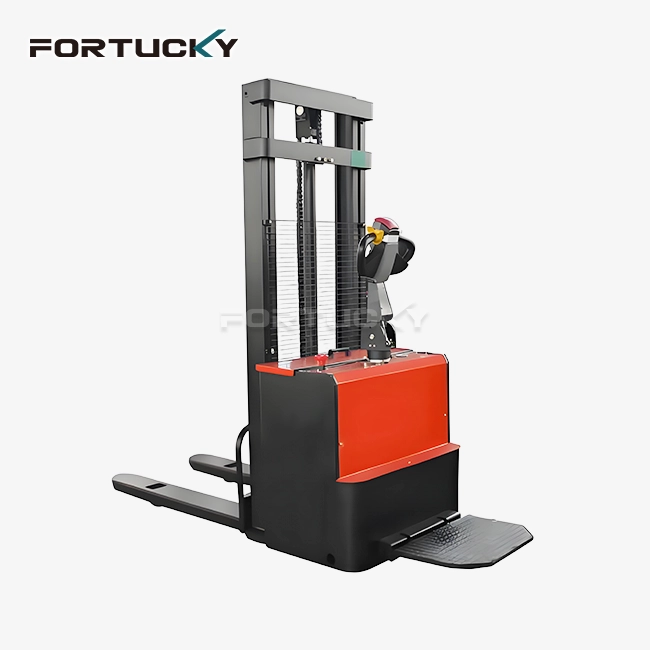
A1: It’s a Light duty Electric Stacker, also a walking all-electric stacker truck.
Q2: What’s the standard load capacity of this electric stacker?
A2: The standard load capacity is 1 ton (1T), and the load weight can be customised according to customer requirements.
Q3: How high can this stacker lift goods?
A3: The maximum hoisting height is 3000mm.
Q4: Is this stacker powered manually or electrically?
A4: It’s fully electric-driven, which helps improve work efficiency.
Q5: What battery configuration does it use?
A5: It’s equipped with a 24V/80V/Ah battery.
Q6: Where is this light-duty electric stacker suitable for use?
A6: It’s suitable for loading, unloading and transporting in factories, warehouses and other places.
Transform Your Narrow Aisle Operations with Fortucky's Advanced Light Duty Electric Stacker Solutions
Maximise your warehouse light-duty electric stacker efficiency with Fortucky's cutting-edge light-duty electric stacker technology, engineered specifically for narrow aisle environments. Our comprehensive solutions combine proven performance with exceptional value, featuring 1,000kg capacity units with 850mm vehicle width and advanced ergonomic controls. As a trusted light-duty electric stacker manufacturer serving over 1,000 global customers, Fortucky delivers customised automation solutions backed by our worldwide service network and expert engineering support. Contact sales@fortuckyrobot.com today to discover how our intelligent material handling systems can optimise your operations while reducing costs and enhancing safety standards.
References
1. Material Handling Institute. "Electric Stacker Design Standards for Narrow Aisle Applications." Industrial Equipment Guidelines, 2023.
2. Warehouse Operations Research Council. "Comparative Analysis of Light-Duty vs Heavy-Duty Stacker Performance in Confined Spaces." Logistics Technology Review, 2023.
3. International Safety Equipment Association. "Battery-Powered Material Handling Equipment Safety Protocols." Industrial Safety Standards Manual, 2022.
4. Supply Chain Management Institute. "ROI Analysis of Electric vs Manual Stacker Systems in Modern Warehouses." Operations Efficiency Quarterly, 2023.
5. European Materials Handling Federation. "Technical Specifications for Narrow Aisle Material Handling Equipment." Equipment Standards Handbook, 2023.
6. American Society of Material Handling Engineers. "Procurement Guidelines for Electric Stacker Systems in Industrial Applications." Engineering Best Practices Journal, 2022.
Learn about our latest products and discounts through SMS or email