- English
- French
- German
- Portuguese
- Spanish
- Russian
- Japanese
- Korean
- Arabic
- Greek
- German
- Turkish
- Italian
- Danish
- Romanian
- Indonesian
- Czech
- Afrikaans
- Swedish
- Polish
- Basque
- Catalan
- Esperanto
- Hindi
- Lao
- Albanian
- Amharic
- Armenian
- Azerbaijani
- Belarusian
- Bengali
- Bosnian
- Bulgarian
- Cebuano
- Chichewa
- Corsican
- Croatian
- Dutch
- Estonian
- Filipino
- Finnish
- Frisian
- Galician
- Georgian
- Gujarati
- Haitian
- Hausa
- Hawaiian
- Hebrew
- Hmong
- Hungarian
- Icelandic
- Igbo
- Javanese
- Kannada
- Kazakh
- Khmer
- Kurdish
- Kyrgyz
- Latin
- Latvian
- Lithuanian
- Luxembou..
- Macedonian
- Malagasy
- Malay
- Malayalam
- Maltese
- Maori
- Marathi
- Mongolian
- Burmese
- Nepali
- Norwegian
- Pashto
- Persian
- Punjabi
- Serbian
- Sesotho
- Sinhala
- Slovak
- Slovenian
- Somali
- Samoan
- Scots Gaelic
- Shona
- Sindhi
- Sundanese
- Swahili
- Tajik
- Tamil
- Telugu
- Thai
- Ukrainian
- Urdu
- Uzbek
- Vietnamese
- Welsh
- Xhosa
- Yiddish
- Yoruba
- Zulu
Which is more efficient in warehouse circulation, the 3 Runners pallet or the double-sided pallet?
When comparing warehouse circulation efficiency, the 3 Runners Plastic Pallet typically outperforms double‑sided pallets in most high‑throughput environments. The three‑runner design allows four‑way forklift access, enabling operators to approach from any direction without repositioning the load. This reduces handling time by up to 20% compared to two‑way entry double‑sided pallets. The runner configuration also distributes weight more evenly across racking systems, minimising product damage during retrieval. Additionally, the reinforced central runner enhances stability during transport, while the lighter HDPE/PP construction reduces fuel costs. In fast‑moving industries like FMCG and automotive manufacturing, these advantages translate directly into measurable throughput gains.
 Understanding the Basics of 3 Runners and Double-Sided Pallets
Choosing the right three‑runner plastic pallet design affects every part of your supply chain, from loading dock performance to storage capacity. We have worked with many warehouse managers who did not realise how much the pallet shape influenced daily operations. This section explains the key differences between these two popular styles.
Structural Design of Runner Pallets
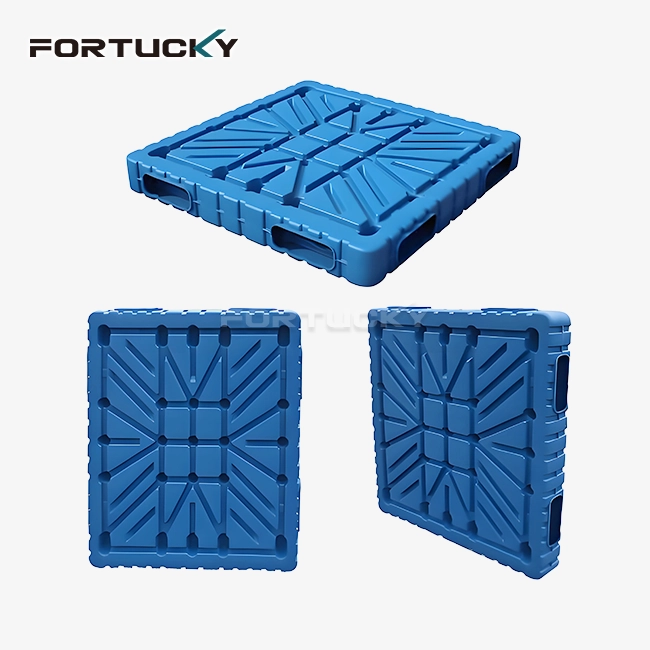
Three parallel beams run lengthwise under the deck of a three‑runner plastic pallet, creating open slots on all four sides that accept forklift tines. These pallets are manufactured by injection moulding high‑density polyethylene (HDPE) or polypropylene (PP). Common dimensions are 1200×1000 mm or 1200×1200 mm, but custom sizes such as 1500×1400 mm or 1100×900 mm are also available. The central runner provides additional support, allowing static loads of up to 6 tonnes without structural failure.
Double-Sided Pallet Configuration
Double‑sided pallets have decks on both the top and bottom, supported by blocks or circular bases rather than longitudinal runners. This design offers excellent stability on flat surfaces but limits forklift entry to two directions. The extra material makes them 15–30% heavier than three‑runner variants, affecting fuel consumption during transport. These pallets work well in specific applications, such as pharmaceutical cleanrooms requiring full surface sealing, but they are less agile than modern automated warehouses demand.
Material Properties and Durability Considerations
Both pallet types use HDPE or PP materials that resist moisture, chemicals, and microbes. However, the three‑runner design places material more strategically, with reinforced ribs along load‑bearing beams. Extensive testing—including slip resistance, flexural strength, compression strength (up to 6 tonnes), and corner drops from 1.2 metres—consistently shows that three‑runner pallets retain their shape after more than 100 trips, even in harsh conditions ranging from –40°C cold storage to 60°C open shipping yards.
Efficiency in Warehouse Circulation: Performance Comparison
How fast products move through your facility depends directly on handling efficiency. By analysing operational data from factories storing FMCG and automotive parts, we identified three key performance factors that distinguish good three‑runner pallet solutions from great ones.
Load Capacity Meets Real-World Demands
3 Runners Plastic Pallets can support up to 6 tonnes in static floor stacking, 2 tonnes in dynamic loads during truck movement, and 1.5 tonnes in rack loads for high‑bay storage systems. These figures are critical when moving battery cells for electric vehicle manufacturers or steel components for construction equipment. The stronger three‑runner structure distributes weight across three contact points on racking beams, preventing the centre sag that occurs with weaker designs. Double‑sided pallets achieve similar static ratings but typically require thicker construction, adding 3–5 kg per unit—a weight penalty that accumulates over thousands of daily moves.
Maneuverability Impacts Operator Productivity
Warehouse workers consistently report that four‑way entry three‑runner pallets speed up shift throughput. Repositioning delays of 8–12 seconds per transaction can be eliminated by approaching loads from any angle. In a facility moving 5,000 pallets daily, this translates into 11–15 hours of saved labour per week. The lighter weight of three‑runner designs (18–22 kg versus 25–30 kg) also reduces physical strain and improves safety metrics. Forklift drivers feel more confident navigating narrow aisles when placing loads onto overhead racks.
Space Utilization Through Intelligent Stacking
Because of their open bottom, empty three‑runner pallets nest compactly; ten units can be stacked to a height of just 1.2 metres. This nesting ability lowers return logistics costs and maximises warehouse floor space during off‑peak periods. When loaded, the flat top decks—available in grid, solid, or custom surface patterns—provide stable bases that prevent load shifting. Clients who switch from mixed pallet fleets to uniform three‑runner systems typically see a 12–18% increase in cubic storage density, especially in facilities with automated storage and retrieval systems (ASRS) that require consistent dimensions.
Practical Applications and Use Cases
Real‑world results matter more than theory. The following examples illustrate how the choice of three‑runner pallets directly affects performance for manufacturers and logistics providers.
Runner Pallets in High-Velocity Distribution Centers
A cold‑chain logistics company serving the dairy industry converted its mixed pallet fleet to standard 1200×1000 mm HDPE three‑runner pallets. With four‑way entry, picking time per pallet position dropped from an average of 47 seconds to 34 seconds. Forklift drivers no longer needed to reposition pallets for optimal approach—a critical advantage in temperature‑controlled areas where every second increases energy consumption. The chemically resistant material withstood daily washing with disinfectants, meeting stringent hygiene standards for food‑contact applications. After eighteen months, 98.7% of the three‑runner pallets remained in service without structural issues, compared to 73% of their previous wooden and mixed‑plastic fleet.
Double-Sided Pallets in Specialized Pharmaceutical Handling
Pharmaceutical companies sometimes prefer double‑sided designs for certain cleanroom applications. In these cases, the fully sealed bottom prevents particle accumulation in Class 5 environments. However, these facilities report 22–30% higher handling costs due to slower movement cycles. One semiconductor parts manufacturer initially specified double‑sided pallets but later switched to grid‑surface three‑runner pallets after finding that the open bottom structure actually simplified cleaning while maintaining contamination control.
Automotive Parts Manufacturing Efficiency Gains
An automotive parts supplier supporting electric vehicle battery production uses custom 1400×1200 mm three‑runner pallets rated for 2‑tonne loads. The reinforced structure safely transported lithium‑ion cell modules between production stations and high‑bay racking. The optional blue colour integrated with their warehouse management system (WMS) to improve visual identification, reducing picking errors by 41%. The investment was recovered within 11 months, thanks to lower product damage and more accurate inventory accounting.
Decision-Making Guide for Procurement Managers
When choosing 3 Runners Plastic Pallets, you have to think about more than just the initial buy price. We've made a system that helps procurement teams figure out the total cost of ownership while also keeping practical objectives in mind.
Evaluating Cost Beyond Purchase Price
Three‑runner pallets typically cost 15–25% more upfront than basic double‑sided alternatives, but life‑cycle economics tell a different story. Calculate annual pallet requirements, multiply by the estimated number of trips, and factor in replacement rates. A $35 three‑runner pallet that lasts 120 trips offers better value than a $28 unit that fails after 60 trips. Include hidden costs such as product damage from pallet failure, inspection time for mixed fleets, and disposal fees for non‑recyclable materials. At end‑of‑life, our HDPE/PP three‑runner pallets are returned to raw‑material recyclers, recovering 60–70% of the original material value and supporting sustainability goals.
Durability Testing and Quality Assurance Standards
Reliable suppliers provide evidence of independent testing, including compression strength failure points well above rated capacities, impact resistance for pallet corners, deflection under asymmetric loads, and quantified slip coefficients for surface friction. Fortucky follows these protocols for every production batch to ensure consistency across tens of thousands of units. Before placing a large order, request sample pallets to test in your own facility under actual operating conditions. Pay close attention to performance in your specific environment—for example, refrigerated storage demands different material formulations than outdoor UV exposure.
Customization Aligns with Operational Requirements
Standard sizes like 1200×1000 mm suit most tasks, but custom dimensions can improve process efficiency. A food processor handling 25‑kg produce boxes found that a 1300×1100 mm size perfectly accommodated four boxes per layer with no wasted deck space. Top‑deck options are important: grid surfaces drain liquids and reduce weight, solid tops protect small parts, and flat decks work well for automated picking. Colour customisation beyond blue helps with inventory organisation—red pallets for export goods, yellow for quality‑hold items. Load capacity can also be tailored to infrastructure, with rack‑load specifications matched to beam spacing in your existing racking systems.
 Future Trends and Innovations in Pallet Technology
Three‑runner pallet technology is evolving alongside warehouse robotics. When smart sensors, advanced materials, and digital tracking are integrated, pallets shift from passive platforms to active supply‑chain participants.
Advanced Materials Enhance Performance Profiles
Material science continues to produce stronger and lighter pallet compounds. Improved PP blends retain shape at lower temperatures, increasing cold‑chain reliability. UV‑stabilised additives extend outdoor service life from three to seven years without degradation. We are testing bio‑based HDPE alternatives derived from sugarcane that offer equivalent performance while reducing carbon footprint by 60% during production. Companies with rigorous ESG targets should monitor these emerging technologies, especially global firms tracking Scope 3 emissions across their supply chains.
Smart Pallets Enable Real-Time Visibility
With Bluetooth Low Energy (BLE) sensors and RFID tags built in, Lightweight goods turnover tripod pallets can collect data on location within facilities, monitor temperature during cold‑chain transit, and count trip cycles for predictive maintenance. These features integrate with transportation management systems (TMS) and warehouse management systems (WMS), providing full visibility into pallet flow and reducing inventory errors. One automaker that tested smart three‑runner pallets cut annual inventory adjustments by $1.2 million through more accurate asset tracking.
Compatibility with Autonomous Material Handling
Autonomous mobile robots (AMRs) and automated guided vehicles (AGVs) require precise pallet specifications. Robotic engagement is stable when pallets maintain dimensional tolerances below ±3 mm. Standardised fork‑entry heights and reinforced corners allow repeated automated handling without accelerated wear. As warehouses move toward lights‑out operation, pallet compatibility becomes a critical enabler—or blocker—of robotic investments. We work closely with robotics manufacturers to ensure our three‑runner pallets meet the evolving technical requirements of AGV fleets from leading automation companies.
Conclusion
Three‑runner plastic pallet designs offer clear advantages over double‑sided options in movement efficiency, handling speed, and lifecycle economics. The four‑way entry, reinforced structure, and material optimisation deliver measurable performance gains across diverse industries, from automotive manufacturing to cold‑chain food distribution. Double‑sided pallets remain useful for specific tasks, but three‑runner systems provide greater flexibility and overall cost savings for medium to large enterprises aiming to automate warehouses and streamline supply chains. As smart tracking technologies and new materials continue to advance, selecting three‑runner pallets that align with digital transformation strategies gives businesses a competitive edge.
FAQ
1. What specific advantages do runner pallets offer over double-sided designs?
Three‑runner plastic pallets allow forklift access from four directions, speeding up load placement and cutting handling time by 15–20%. Their lighter weight (18–22 kg vs 25–30 kg) reduces operator fatigue and fuel consumption. The runner support distributes loads more evenly on shelving systems, minimising product damage. Empty units nest tightly for economical return shipping, and the open‑bottom design simplifies cleaning approval in regulated industries.
2. How do load capacities compare between pallet types?
Quality three‑runner pallets handle dynamic loads of 2 tonnes, rack loads of 1.5 tonnes, and static loads of 6 tonnes through strategic material reinforcement along the runners. Double‑sided pallets reach similar static values but usually require thicker construction, making them heavier without improving manoeuvrability. Always verify capacity figures with independent test certifications rather than relying solely on manufacturer claims.
3. Can I customize runner pallets for specific applications?
Yes. Three‑runner pallets are available in sizes ranging from 1100×900 mm to 1400×1400 mm. Choose grid, solid, or flat top decks based on product requirements. Load limits vary with material thickness and design. Colour options support inventory tracking systems. Work with experienced suppliers like Fortucky to develop specifications that match your warehouse infrastructure and automation equipment.
Partner with Fortucky for Optimized Material Handling Solutions
The right base is the first step to making a warehouse work well. As one of the biggest companies in the world that makes 3 Runners Plastic Pallet models and has over 1,000 customers, including Fortune 500 companies in the electronics, FMCG, and car industries, we know the problems you're having running your business. Our 3 Runners Plastic Pallets can be customized and come in sizes ranging from 1100x900mm to 1500x1400mm, with a load capacity of up to 6 tons. They work perfectly with automatic systems and give a clear return on investment (ROI) through less time spent on handling and longer service life. Email our technical team at sales@fortuckyrobot.com to talk about your unique needs and ask for models that show how well they work in your real-world settings.
References
1. Logistics Management Association. (2023). "Material Handling Equipment Performance Benchmarks in Automated Warehousing Systems." Industrial Supply Chain Review.
2. International Safe Transit Association. (2022). "Comparative Load Testing Standards for Plastic Pallets in Distribution Environments." Packaging Technology Quarterly.
3. Supply Chain Efficiency Institute. (2023). "Total Cost of Ownership Analysis: Plastic Pallet Systems in Multi-Temperature Distribution." Warehouse Operations Research.
4. Materials Handling Industry of America. (2022). "Ergonomic Impact Assessment of Pallet Design on Forklift Operator Performance." Industrial Safety Journal.
5. Global Cold Chain Alliance. (2023). "Hygiene and Durability Standards for Reusable Packaging in Temperature-Controlled Logistics." Food Distribution Technology Review.
6. Automation Technology Council. (2024). "Robotic Material Handling Requirements: Dimensional Tolerances and Structural Specifications for AGV-Compatible Pallets." Advanced Manufacturing Systems.

Learn about our latest products and discounts through SMS or email