- English
- French
- German
- Portuguese
- Spanish
- Russian
- Japanese
- Korean
- Arabic
- Greek
- German
- Turkish
- Italian
- Danish
- Romanian
- Indonesian
- Czech
- Afrikaans
- Swedish
- Polish
- Basque
- Catalan
- Esperanto
- Hindi
- Lao
- Albanian
- Amharic
- Armenian
- Azerbaijani
- Belarusian
- Bengali
- Bosnian
- Bulgarian
- Cebuano
- Chichewa
- Corsican
- Croatian
- Dutch
- Estonian
- Filipino
- Finnish
- Frisian
- Galician
- Georgian
- Gujarati
- Haitian
- Hausa
- Hawaiian
- Hebrew
- Hmong
- Hungarian
- Icelandic
- Igbo
- Javanese
- Kannada
- Kazakh
- Khmer
- Kurdish
- Kyrgyz
- Latin
- Latvian
- Lithuanian
- Luxembou..
- Macedonian
- Malagasy
- Malay
- Malayalam
- Maltese
- Maori
- Marathi
- Mongolian
- Burmese
- Nepali
- Norwegian
- Pashto
- Persian
- Punjabi
- Serbian
- Sesotho
- Sinhala
- Slovak
- Slovenian
- Somali
- Samoan
- Scots Gaelic
- Shona
- Sindhi
- Sundanese
- Swahili
- Tajik
- Tamil
- Telugu
- Thai
- Ukrainian
- Urdu
- Uzbek
- Vietnamese
- Welsh
- Xhosa
- Yiddish
- Yoruba
- Zulu
Are Full Electric Pallet Jack Worth It for Your Warehouse in 2026?
Quick Answer: Yes, of course. Full electric pallet jacks are a smart investment for modern warehouses and retail stores aiming to meet environmental goals, increase throughput, and reduce labor costs. As we move into 2026, these automated material handling solutions are no longer a "nice-to-have"—they have become essential for shipping operations that demand safety, efficiency, and scalability. Thanks to advancements in battery technology, smart control systems, and ergonomic design, today's electric pallet jacks deliver a measurable return on investment (ROI) while solving critical issues such as operator fatigue and operational bottlenecks.
 Understanding Full Electric Pallet Jacks: Features and Benefits
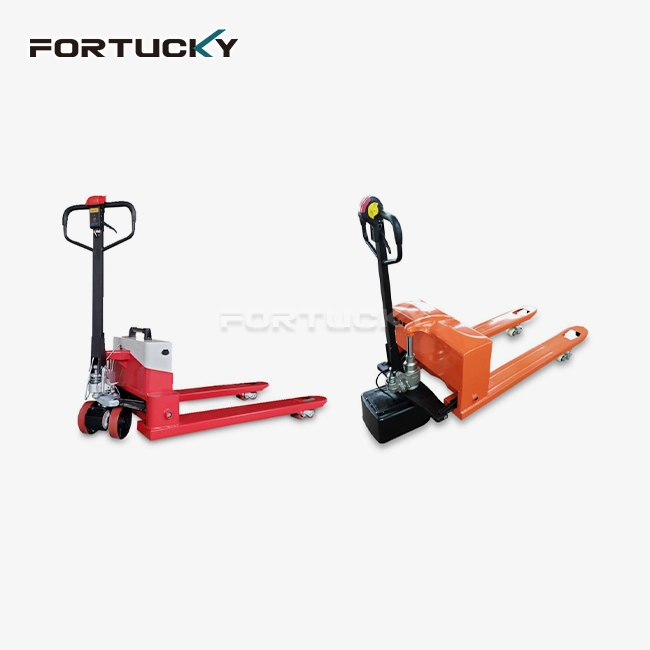
Modern warehouses require equipment that is powerful, precise, and operator-friendly. Full electric pallet jacks meet these demands by integrating powered travel and lifting functions into a compact, highly maneuverable platform designed for horizontal movement of palletized goods.
Core Technical Architecture
Today's electric pallet jacks are built on robust engineering principles that ensure long-term reliability. The frame is constructed from high-manganese steel, offering exceptional strength and resistance to deformation under normal use. The dual front wheels provide excellent working balance, which is particularly beneficial when navigating narrow warehouse aisles or maneuvering around obstacles. Heavy-duty plate chains connect the lifting mechanism to powerful motors, creating a drive system capable of handling heavy loads without excessive wear.
Compared to older generations, the electronic control system represents a major leap forward. Intelligent fault alerts notify operators when maintenance is due, preventing minor issues from escalating into costly downtime. Stepless speed control enables precise handling during delicate operations, reducing product damage risks and enhancing personnel safety. This adaptability is especially valuable in environments where workers must transition between open factory floors and congested loading docks.
Battery Technology and Operational Endurance
Power systems have evolved significantly, with all professional-grade models now featuring large-capacity batteries as standard. Units equipped with 120Ah or 210Ah batteries can operate continuously throughout an eight-hour shift, eliminating productivity losses associated with mid-shift battery swaps. The 24V or 48V architecture strikes an optimal balance between power delivery and energy efficiency. Smart charging technologies extend battery lifespan while reducing electricity consumption.
Lithium-ion batteries have become increasingly popular for high-intensity applications. Unlike conventional lead-acid batteries, lithium systems allow opportunity charging during breaks without any memory effect, giving multi-shift operations the flexibility to maximize equipment utilization without maintaining large battery inventories. The longer cycle life—often exceeding 2,000 charge cycles—significantly lowers the total cost of ownership, even though the initial investment is higher.
Ergonomic Innovation and Operator Safety
Equipment designers are increasingly prioritizing user health and safety, recognizing that comfortable workers are more productive and less injury-prone. Long-term use is less fatiguing thanks to air-spring handle systems that absorb vibrations, and intuitively placed controls minimize unnecessary hand movements. The tiller head interface places all essential controls within easy reach, enabling operators to maintain proper posture throughout their shifts.
Safety features extend beyond comfort. Anti-rollback protection prevents dangerous backward movement on inclines, while emergency reverse functions keep operators safe in confined spaces. The low-profile design ensures clear sightlines over loaded pallets, reducing the risk of blind-spot accidents in busy warehouses. These engineering choices directly address the musculoskeletal risks associated with manual material handling.
Performance Specifications That Matter
Equipment value is ultimately determined by real-world performance. Models with load capacities ranging from 2,000 kg to 3,000 kg can handle most warehousing tasks—from lightweight electronics packaging to heavy automotive parts. Standard pallet sizes fit comfortably within the 200 mm lift height, and the unit remains compact. Travel speeds of up to 5 km/h strike an effective balance between efficiency and safety when operating near personnel, while the 10° gradeability ensures reliable performance on loading dock ramps.
A turning radius of 1,250 mm enables effortless navigation through standard warehouse aisles without requiring excessive clearance. This quick and precise maneuverability is critical for facilities aiming to maximize every square meter of floor space. With overall dimensions of 1,800 mm (length) × 860 mm (width) × 1,420 mm (height), these units can pass through standard doorways and perform effectively in tight spaces where larger counterbalance forklifts cannot operate.
Full Electric Pallet Jack vs Alternative Solutions: Making an Informed Choice
Selecting the right material handling equipment requires understanding how different options align with your specific operational needs. The market offers various choices, each with its own advantages and trade-offs.
Manual Pallet Jacks: The Baseline Comparison
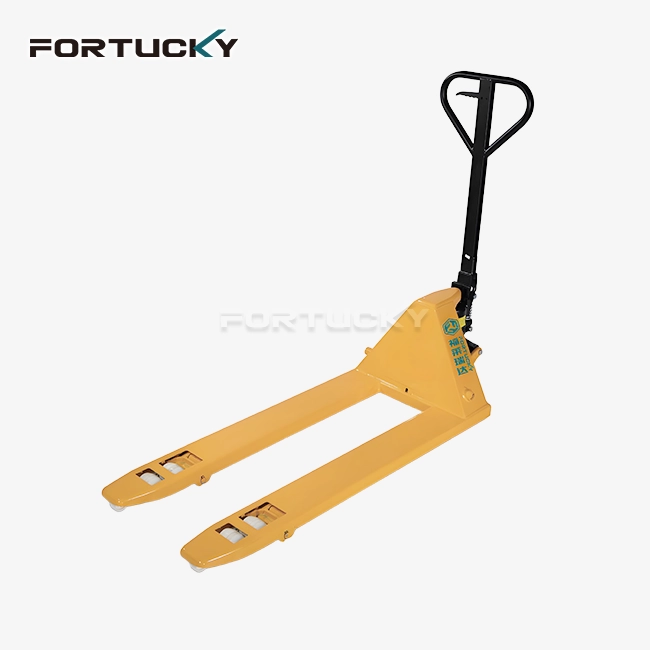
Traditional manual pallet jacks remain in use for low-volume settings due to their low upfront cost and zero energy consumption. However, their physical demands limit throughput and pose significant health risks. Operators must manually pump the hydraulic jack to lift loads, then push or pull weights exceeding 2,000 kg. Such strenuous activity can lead to fatigue-related errors and increased workplace injury risks, which in turn raise insurance costs and hinder employee retention.
These physical hurdles are taken away by electric machinery, such as a full electric pallet jack. A 1.2 kW drive motor moves loads easily, and 2.2 kW to 3 kW lift motors raise pallets at 90 mm per minute with the push of a button. With this power assistance, operators can switch from physical work to skilled machine operation, which lets facilities better use their staff on tasks that add value.
Walkie vs. Rider Configurations
Walk-behind electric pallet jacks are ideal for applications requiring frequent stops and starts. The operator walks alongside the unit, maintaining close control for precise positioning. This configuration excels in congested storage areas where direction changes are constant.
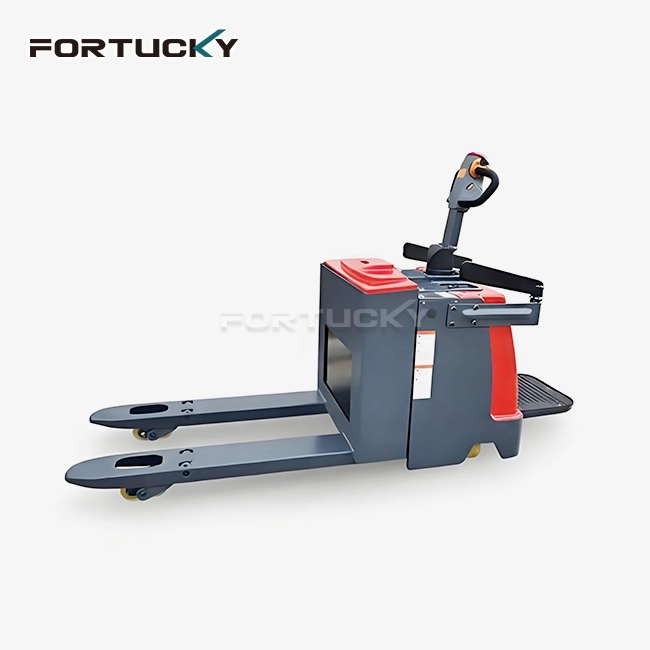
Rider models feature a foldable standing platform, allowing workers to ride during longer transport runs. This design reduces operator fatigue during extended shifts in large warehouses where walking distances can reach several kilometers. Facility layout, typical transport distances, and workflow patterns all influence the optimal choice. Facilities with diverse needs may employ both types, matching the right tool to each task.
Battery Chemistry Considerations
Lead-acid batteries represent a mature, reliable technology with modest upfront costs. They require regular maintenance—including watering and equalization charging—but many organizations have established effective procedures for these tasks. Lead-acid batteries also offer greater stability under heavy loads due to their weight.
Lithium-ion devices command higher upfront prices but deliver substantial operational benefits. Opportunity charging eliminates the need for dedicated charging rooms and battery-swapping stations. Their lighter weight reduces overall equipment mass, saving energy. Longer service life and zero maintenance lower long-term operating costs, though the higher capital investment requires careful financial analysis to determine breakeven points for each operation type.
 Procurement Considerations: Buying, Leasing, or Renting Your Full Electric Pallet Jack
The acquisition strategy significantly affects both short-term cash flow and long-term operational flexibility. Procurement professionals must look beyond the purchase price to maximize the value of their material handling investments.
Direct Purchase Strategies
Outright equipment purchase makes sense for established businesses with predictable long-term needs and available capital. Ownership eliminates monthly lease payments and provides full control over usage and maintenance scheduling. Standardizing fleet equipment enables volume discounts, while depreciation schedules can offer tax advantages that reduce overall cost.
Working with authorized dealers provides manufacturer warranties and access to certified repair networks. Reputable suppliers protect the investment by offering comprehensive specifications, operator training, and parts availability guarantees. Procurement teams should verify dealer credentials and inquire about service response times before finalizing large equipment orders.
Leasing and Rental Alternatives
Leasing spreads costs over time, preserving capital for other operating needs. Operating lease payments may offer tax benefits as they are treated as expenses rather than capital investments. This approach works well for growing facilities or those experiencing seasonal fluctuations, as it allows equipment fleets to adapt to changing demands.
Short-term rentals fill temporary capacity gaps during peak seasons or facility renovations. Rental agreements often include maintenance coverage, simplifying administrative burdens for internal teams. Although daily rental rates are higher, making long-term leasing uneconomical, the flexibility is invaluable when business conditions are uncertain or when testing new equipment configurations.
Financing Mechanisms for Bulk Acquisitions
For large-scale warehouse changes to work, the fleet needs to be standardized across multiple locations, including the use of full-electric hydraulic pallet trucks. Manufacturers and banking partners set up financing plans just for these large purchases, with good terms that reflect lower transaction costs and long-term customer relationships. Payment plans can be matched up with practical cash flows, which can make big equipment purchases easier on the wallet.
Some providers bundle financing with extended warranty coverage and preventive maintenance programs. These all-in-one service packages simplify planning and administration, making them attractive to organizations seeking predictable costs and minimal internal support infrastructure.
Leading Brands and Suppliers of Full Electric Pallet Jacks in 2026
Long-term operational success is directly tied to equipment quality and supplier reliability. While established names capture much of the market's attention, newer providers are offering increasingly competitive options backed by modern manufacturing capabilities and global service networks.
Established Market Leaders
Major companies such as Jungheinrich, Crown, Raymond, Toyota, and Hyster have built their reputations over decades through continuous technological improvement and extensive dealer networks. Their products command premium prices justified by comprehensive warranties, readily available spare parts, and strong resale value. These brands particularly excel in complex applications requiring specialized features or integration with warehouse management systems.
Their service networks span North America, staffed by factory-trained technicians specializing in specific product lines. This geographic coverage ensures rapid assistance when equipment failures threaten operations. However, custom configurations may involve lead times of several months, requiring careful planning for facility expansions or new equipment needs.
Fortucky: Innovation Meets Global Scale
Fortucky has emerged as a strong contender in the intelligent material handling space, leveraging advanced manufacturing capabilities and deep industry expertise gained from over 1,000 successful customer deployments worldwide. The company serves Fortune 500 clients across the automotive, fast-moving consumer goods, technology, and cold chain logistics sectors—all of which demand exceptional reliability and performance.
Fortucky differentiates itself through customer-centric practices, combining technical customization with responsive service. Their 5G-connected smart manufacturing facilities produce equipment featuring cutting-edge control systems while maintaining competitive pricing and delivering exceptional value. A strong R&D team continuously enhances product features, ensuring solutions keep pace with evolving automation trends and Industry 4.0 requirements.
Customization and Integration Capabilities
Modern warehouses increasingly require equipment capable of communicating with enterprise systems. Contemporary full electric pallet jacks can interface with warehouse management systems, transmitting operational metrics and real-time location data that inform inventory decisions and workflow optimization. Battery monitoring systems generate predictive maintenance alerts, enabling facilities to schedule service during planned downtime rather than reacting to unexpected breakdowns.
Fork sizes, wheel materials, and battery amounts are all common places where you can make changes for an electric ride-on pallet truck. Custom fork lengths and widths are helpful for businesses that deal with pallets of different sizes. Facilities with special floors, like epoxy coats, smooth concrete, or outdoor areas, get the most out of their wheels by choosing the right materials. By matching battery capacity to shift patterns and charging infrastructure, you can avoid spending too much on capacity that isn't being used and still make sure the system can last for a long time.
Conclusion
For businesses pursuing efficiency, safety, and competitive advantage, investing in full electric pallet jacks is a clear strategic decision. These units deliver tangible improvements in throughput, operator comfort, and operating costs while supporting sustainability initiatives that increasingly influence customer relationships and regulatory compliance.
Past concerns about reliability—once a legitimate reason for hesitation—have been fully addressed by technological maturity. Intelligent control systems, rugged construction, and advanced battery technologies work together to produce equipment capable of handling demanding multi-shift operations across diverse industrial environments. Success depends on matching specific models to operational requirements and partnering with suppliers who view themselves as collaborators rather than mere vendors.
FAQ
1. What battery life should I expect from electric pallet jack batteries?
With proper maintenance, lead-acid batteries typically last three to five years or 1,000–1,500 charge cycles. Lithium-ion units can achieve 2,000–3,000 cycles and often last seven years or more. Actual lifespan varies significantly depending on charging practices, depth of discharge, and operating temperatures. Opportunity charging during breaks increases equipment availability without accelerating wear.
2. Can these units operate safely on loading dock ramps?
Yes. Well-designed electric pallet jacks equipped with electromagnetic braking systems and anti-rollback protection can handle slopes of up to 10 degrees under full load. The 1.2 kW drive motors provide sufficient power for controlled climbing, while regenerative braking prevents uncontrolled descent. Operators should receive specialized ramp training, as improper technique can create hazards regardless of equipment quality.
3. How does maintenance compare to manual pallet jacks?
Electric units require regular maintenance, including brake, hydraulic, and electrical connection inspections. Brushless AC motors eliminate the carbon brush replacements needed on older DC systems. Overall maintenance costs are higher than those of manual jacks but significantly lower than those of counterbalance trucks. Preventive programs typically include quarterly inspections and annual full service, which can be easily managed through supplier maintenance contracts.
Partner with Fortucky for Your Material Handling Transformation
Getting electric pallet jacks is a long-term choice that will have an effect on how efficiently your business runs for years to come. Fortucky has a reputation for being a reliable maker and seller of full electric pallet jacks. They combine new technology with hands-on support to make sure that projects go smoothly.
Our engineering team works directly with buying staff to come up with options that meet all of your exact needs, whether you run a temperature-controlled drug facility, a high-throughput auto plant, or a complicated FMCG distribution center. We offer solutions that maximize ROI while minimizing operational risk. Our prices are reasonable, we deliver quickly, and we offer full after-sales support. Email our sales team at sales@fortuckyrobot.com to talk about how our electric pallet jacks can help you solve your unique operational problems and put your building in a position to stay ahead of the competition.
References
1. Industrial Truck Association. (2025). "Material Handling Equipment Classification and Safety Standards." ITA Technical Bulletin Series.
2. Modern Materials Handling. (2025). "Annual Warehouse Equipment Survey: Electric Pallet Jack Adoption Trends." Peerless Media LLC.
3. Material Handling Institute. (2024). "Total Cost of Ownership Analysis for Electric vs Manual Material Handling Equipment." MHI Research Department.
4. International Warehouse Logistics Association. (2025). "Ergonomics in Material Handling: Reducing Musculoskeletal Disorders Through Equipment Selection." IWLA Safety Committee Report.
5. Battery University. (2024). "Lithium-Ion vs Lead-Acid in Industrial Applications: Performance Comparison and Lifecycle Analysis." Cadex Electronics Inc.
6. Council of Supply Chain Management Professionals. (2025). "Warehouse Automation ROI Metrics: Equipment Investment Decision Framework." CSCMP Annual State of Logistics Report.

Learn about our latest products and discounts through SMS or email