- English
- French
- German
- Portuguese
- Spanish
- Russian
- Japanese
- Korean
- Arabic
- Greek
- German
- Turkish
- Italian
- Danish
- Romanian
- Indonesian
- Czech
- Afrikaans
- Swedish
- Polish
- Basque
- Catalan
- Esperanto
- Hindi
- Lao
- Albanian
- Amharic
- Armenian
- Azerbaijani
- Belarusian
- Bengali
- Bosnian
- Bulgarian
- Cebuano
- Chichewa
- Corsican
- Croatian
- Dutch
- Estonian
- Filipino
- Finnish
- Frisian
- Galician
- Georgian
- Gujarati
- Haitian
- Hausa
- Hawaiian
- Hebrew
- Hmong
- Hungarian
- Icelandic
- Igbo
- Javanese
- Kannada
- Kazakh
- Khmer
- Kurdish
- Kyrgyz
- Latin
- Latvian
- Lithuanian
- Luxembou..
- Macedonian
- Malagasy
- Malay
- Malayalam
- Maltese
- Maori
- Marathi
- Mongolian
- Burmese
- Nepali
- Norwegian
- Pashto
- Persian
- Punjabi
- Serbian
- Sesotho
- Sinhala
- Slovak
- Slovenian
- Somali
- Samoan
- Scots Gaelic
- Shona
- Sindhi
- Sundanese
- Swahili
- Tajik
- Tamil
- Telugu
- Thai
- Ukrainian
- Urdu
- Uzbek
- Vietnamese
- Welsh
- Xhosa
- Yiddish
- Yoruba
- Zulu
Drive In Racking System Layout and Design Guide
It's not enough to just stack boxes higher when you're planning an efficient warehouse. You need to make every square metre count. It has been shown that drive-in storage racks are a good way to increase density without losing structural stability. This book explains the basic rules of layout, things to think about when designing, and steps for strategy planning that production and logistics leaders need to take to turn unused warehouse space into large storage areas. If you know how to set up these systems correctly, you can get a measurable return on investment (ROI) and improve business efficiency, whether you're handling inventory for car parts, fast-moving consumer goods, or cold chain products.
 Understanding the Core Mechanics of High-Density Storage
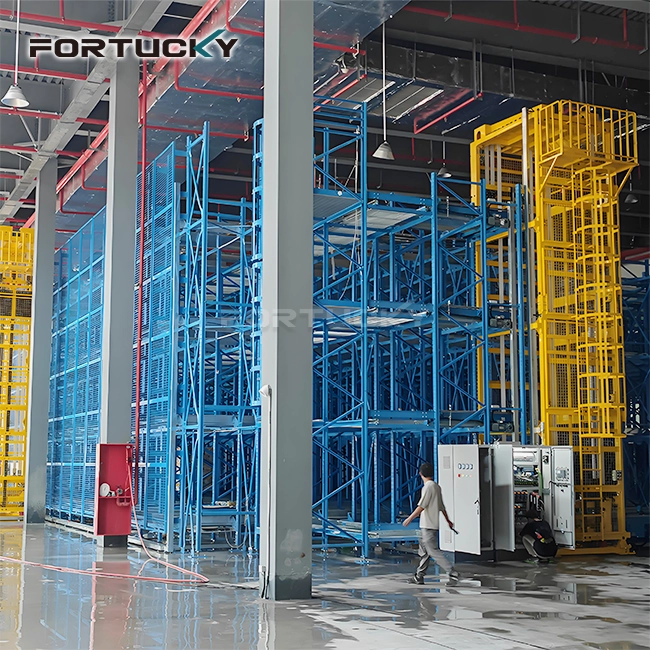
Different from regular selection systems, drive-in shelving operates on a fundamentally different principle. It eliminates unnecessary aisles between rack rows, allowing forklifts to enter the storage lanes directly and place pallets onto long rails that extend deep into the facility.
This method follows a "last-in, first-out" (LIFO) flow of goods, which works very well for uniform products sold at regular intervals. Consider a beverage company storing thousands of similar SKUs that will be released during specific seasons—the LIFO concept performs properly in such scenarios.
Key structural components include vertical uprights, load beams, horizontal guide rails, back braces, and top-tie supports. The guide rails bear the weight of the load and protect the uprights from forklift impacts—a crucial feature in high-throughput environments where equipment operates continuously across multiple shifts.
Typically, drive-in systems achieve 80% space utilization, compared to 50% with standard selective racking. For businesses managing expensive real estate or temperature-controlled facilities, this 30% density increase translates directly into capital cost savings. Industries such as cold storage, pharmaceuticals, and new energy battery manufacturing particularly benefit from this compact footprint.
Critical Layout Considerations for Different Industries
The automotive and industrial sectors require layouts that accommodate varying pallet sizes and weight distributions. To store heavy parts, uprights must be reinforced and steel gauges increased. Layout engineers must calculate the load capacity for each lane depth, accounting for the increasing box weight as pallets stack toward the entry point.
Despite the constraints of LIFO, FMCG and food processing companies prioritize fast changeover. Smart planning strategies involve dedicating specific lanes to fast-moving SKUs while placing slower items in deeper channels. This segmentation prevents product stagnation without requiring first-in, first-out (FIFO) capability.
Cold chain logistics presents unique challenges. Temperature fluctuations can weaken steel, and confined spaces demand meticulous dimensional planning. Drive-through layouts—accessible from both ends—provide some FIFO functionality for perishable goods that require tighter cycle control. The design must strike a balance between density maximization and expiry tracking.
Industries that use electronics and high-tech manufacturing work with fragile goods in drive-in storage racks. Wider guide rails, less width in the lanes, and better side bracing all help to decrease vibrations while the forklift is moving. Layout designs include safety gaps that keep storage densities at a good level while protecting fragile items.
Heavy industry—such as steel processing, construction machinery, and industrial equipment—requires maximum load-bearing capacity. Layout specifications include deeper base anchoring, thicker flooring, and increased spacing between uprights. Engineers use finite element analysis to ensure structural integrity under extreme loads.
Designing Entry Lanes and Traffic Flow Patterns
Entry lane width directly affects forklift maneuverability and safety. Standard configurations range from 2.4 to 3.0 metres, but can be adjusted based on equipment size and operator skill. Wider lanes reduce collision risk but sacrifice storage space—a trade-off that requires careful evaluation.
Traffic flow patterns significantly impact efficiency. Single-entry designs work best where pure density outweighs product movement needs. Dual-entry drive-through systems facilitate two-way travel in facilities serving multiple production lines or shipping docks simultaneously.
Calculating turning radius prevents bottlenecks. When trucks exit lanes with loads, they need sufficient room to manoeuvre before entering adjacent aisles. Layout designers create detailed vehicle path maps, identifying potential congestion points. This planning step avoids expensive redesigns after installation.
Measuring vertical clearance between load bars demands precision. Insufficient height damages boxes during placement, while excessive gaps waste cubic capacity. For most operations, a 100–150 mm clearance above the box is recommended, with allowance for overhanging product or irregular pallet configurations.
Integrating Automation and Digital Systems
Modern drive-in installations increasingly incorporate warehouse management system (WMS) integration for real-time inventory visibility. Sensors mounted on guide rails track pallet positions, feeding data to centralized management platforms. This digital layer transforms static storage into a smart system that provides actionable analytics.
Automated guided vehicles (AGVs) and autonomous forklifts further elevate efficiency. These systems require enhanced layout precision—guide rails must align within millimetre tolerances, and floor flatness specifications become considerably tighter. Digital twin modelling during the design phase helps identify potential automation conflicts before physical installation.
Warehouse control system (WCS) coordination enables dynamic lane assignment. Rather than permanently dedicating lanes to specific SKUs, intelligent systems allocate storage based on real-time demand forecasting. This flexibility maximizes utilization while maintaining retrieval efficiency—a capability particularly valuable for enterprises undergoing digital transformation.
Manufacturing execution system (MES) integration connects warehouse operations with upstream production scheduling. When manufacturing lines signal inventory requirements, the storage system automatically prepares retrieval sequences. This coordination reduces production line downtime, a critical metric for automotive assembly plants and electronics manufacturers.
Industry 4.0 readiness demands scalable architecture. Layout designs now incorporate provisions for future sensor networks, power distribution for automated equipment, and communication infrastructure supporting IoT devices. Enterprises investing in these foundations avoid disruptive retrofits as technology evolves.
Load Capacity Calculations and Safety Protocols
Engineering calculations begin with dead load assessment—the cumulative weight of stored goods, pallets, and structural components. Live loads account for dynamic forces during forklift operation, including acceleration, braking, and lateral movement. Seismic considerations apply in certain geographical regions, requiring additional bracing.
Material specifications directly impact load capacity. High-tensile steel uprights withstand greater stress than standard grades, enabling taller configurations or heavier loads. Cold-formed profiles offer excellent strength-to-weight ratios, though welded assemblies may suit extreme-duty applications.
Drive-in pallet racking safety factors incorporate variables like steel quality consistency, installation tolerances, and long-term fatigue. Reputable manufacturers apply a minimum 1.5x safety margin, though industries such as pharmaceuticals or aviation often demand higher multiples. This conservatism prevents catastrophic failures that could endanger personnel or damage high-value inventory.
Regular inspection protocols maintain structural integrity over decades of operation. Annual assessments check for upright damage, beam deflection, anchor bolt tension, and protective component wear. Enterprises with robust maintenance programs report significantly longer system lifespans and fewer safety incidents.
Load distribution across floor slabs requires geotechnical validation. Warehouse floors must support concentrated point loads where upright bases transfer cumulative weight. Inadequate slab thickness or improper soil compaction leads to differential settling, creating dangerous rack misalignment over time.
Customization Strategies for Diverse Product Portfolios
Adjustable beam heights accommodate changing inventory profiles. Modular designs allow reconfiguration without complete system replacement, protecting capital investments as business needs evolve. This flexibility particularly benefits third-party logistics providers serving diverse clientele.
Mixed SKU strategies employ varying lane depths within single installations. Fast-moving products occupy shallow three-pallet lanes for quicker access, while slow-movers extend six or more pallets deep. This hybrid approach balances density optimization with operational practicality.
Colour customization extends beyond aesthetics. Colour-coded lanes simplify warehouse navigation, reduce picking errors, and enhance safety by clearly marking restricted zones. Enterprises operating multiple facilities benefit from standardized colour schemes that ease cross-site workforce mobility.
Specialized applications drive unique modifications. Pharmaceutical cold storage might integrate insulated panels between rack bays, creating isolated temperature zones. Hazardous material storage incorporates spark-resistant coatings and enhanced ventilation provisions.
Dimension variability accommodates non-standard pallet sizes. Global manufacturers dealing with mixed regional pallet standards—EUR, CHEP, North American GMA—configure adjustable guide rail positions. This adaptability prevents the need for multiple incompatible systems within a single facility.
 Evaluating Total Cost of Ownership
Initial capital expenditure represents only part of the investment equation. Installation costs vary based on site preparation requirements, existing infrastructure compatibility, and project timeline constraints. Enterprises retrofitting operational warehouses face higher labour costs due to workaround scheduling compared to greenfield installations.
Operational expenses include maintenance, inspection, and eventual component replacement. High-quality systems with proper care deliver 20-30 year lifespans, though intensive use environments may require more frequent upkeep. Budgeting for preventive maintenance prevents unexpected downtime that disrupts supply chain continuity.
Energy efficiency considerations affect long-term costs. Well-designed layouts reduce forklift travel distances, cutting fuel consumption and equipment wear. In cold storage applications, optimized density lowers refrigeration requirements per pallet stored—a substantial ongoing expense reduction.
ROI calculations must account for productivity improvements and throughput gains. Faster storage and retrieval cycles mean existing equipment handles greater volume without fleet expansion. Labour efficiency improvements compound over years of operation, often exceeding the value of initial space savings.
Scalability impacts future-state costs. Modular systems supporting phased expansion avoid the massive capital outlay of oversized initial installations. This approach aligns investment timing with revenue growth, improving cash flow management and reducing financial risk.
Real-World Performance Across Manufacturing Sectors
Automotive parts suppliers leverage last-in-first-out (LIFO) storage racks to manage thousands of component SKUs with varying turnover rates. One tier-one supplier increased warehouse capacity by 65% without facility expansion, deferring a multi-million dollar construction project. Strategic lane depth assignment matched component velocity profiles, maintaining retrieval efficiency despite higher density.
FMCG distributors handling beverage products appreciate the system's ability to store promotion inventory compactly during off-peak periods. Seasonal demand spikes are accommodated within existing footprints rather than requiring temporary warehouse leases. The LIFO flow aligns naturally with date-coded products sharing identical expiration horizons.
Cold chain operators report energy savings exceeding 20% after transitioning from lower-density alternatives. Reducing refrigerated cubic volume directly cuts compressor runtime. Enhanced insulation efficiency from compact layouts further improves thermal performance, particularly in ultra-low temperature pharmaceutical storage.
Electronics manufacturers value the customization potential for varied component sizes. Adjustable configurations accommodate everything from small component reels to large display panels within integrated systems. This versatility reduces the need for multiple incompatible storage solutions cluttering production facilities.
Heavy industry applications demonstrate the structural robustness these systems achieve with proper engineering. Steel service centers store coil and plate inventory weighing multiple tons per pallet. Reinforced designs withstand both static loads and dynamic forces from overhead crane operations in adjacent areas.
Conclusion
Strategic drive-in racking design transforms warehouse operations from space-constrained bottlenecks into competitive advantages. Thoughtful layout planning considers industry-specific requirements, integrates digital capabilities, and balances density against operational workflow. The 80% space utilization these systems deliver provides immediate capital relief while supporting long-term growth. Enterprises investing in properly engineered solutions gain not just storage capacity but operational resilience. Partnering with experienced providers ensures designs incorporate proven best practices refined across thousands of global implementations. Smart warehouse infrastructure becomes the foundation supporting broader digital transformation and Industry 4.0 initiatives.
Partner With a drive-in storage racks manufacturer that delivers results
Successful high-density drive in storage racks implementation requires more than quality hardware—it demands a partner with proven expertise across global industries. Fortucky brings comprehensive design capabilities, rapid deployment timelines, and localized technical support to enterprises seeking competitive advantage through warehouse optimization. Our engineering teams have delivered customized solutions for Fortune 500 manufacturers, automotive leaders, and logistics innovators worldwide. Contact our specialists at sales@fortuckyrobot.com to discuss how tailored drive-in systems can transform your operational efficiency and ROI.
References
1. "Industrial Storage Systems: Engineering Principles for High-Density Warehousing Solutions," Society of Logistics Engineers, 2023.
2. "Warehouse Design and Material Handling Equipment Selection," International Journal of Production Research, Volume 61, 2022.
3. "Steel Storage Rack Systems: Structural Design Guidelines and Load Capacity Standards," Materials Handling Institute Technical Publications, 2023.
4. "Automated Warehouse Integration: Connecting Physical Infrastructure with Digital Control Systems," Supply Chain Management Review, 2024.
5. "Cold Chain Logistics Infrastructure: Temperature-Controlled Storage System Design," Journal of Food Distribution Research, Volume 54, 2023.
6. "Cost-Benefit Analysis of High-Density Storage Solutions in Modern Manufacturing," Industrial Engineering and Management Science Quarterly, 2022.

Learn about our latest products and discounts through SMS or email