- English
- French
- German
- Portuguese
- Spanish
- Russian
- Japanese
- Korean
- Arabic
- Greek
- German
- Turkish
- Italian
- Danish
- Romanian
- Indonesian
- Czech
- Afrikaans
- Swedish
- Polish
- Basque
- Catalan
- Esperanto
- Hindi
- Lao
- Albanian
- Amharic
- Armenian
- Azerbaijani
- Belarusian
- Bengali
- Bosnian
- Bulgarian
- Cebuano
- Chichewa
- Corsican
- Croatian
- Dutch
- Estonian
- Filipino
- Finnish
- Frisian
- Galician
- Georgian
- Gujarati
- Haitian
- Hausa
- Hawaiian
- Hebrew
- Hmong
- Hungarian
- Icelandic
- Igbo
- Javanese
- Kannada
- Kazakh
- Khmer
- Kurdish
- Kyrgyz
- Latin
- Latvian
- Lithuanian
- Luxembou..
- Macedonian
- Malagasy
- Malay
- Malayalam
- Maltese
- Maori
- Marathi
- Mongolian
- Burmese
- Nepali
- Norwegian
- Pashto
- Persian
- Punjabi
- Serbian
- Sesotho
- Sinhala
- Slovak
- Slovenian
- Somali
- Samoan
- Scots Gaelic
- Shona
- Sindhi
- Sundanese
- Swahili
- Tajik
- Tamil
- Telugu
- Thai
- Ukrainian
- Urdu
- Uzbek
- Vietnamese
- Welsh
- Xhosa
- Yiddish
- Yoruba
- Zulu
Optimizing Warehouse Efficiency with Electric Pallet Jacks
When we think about how productive a building is, the machines that move things around the floor are very important. A Full Electric Pallet jack is one of the best solutions for automating horizontal lifting and movement without the expense and complexity of installing a full-scale forklift system. These machines eliminate manual pumping, reduce operator effort, and accelerate workflows in warehouses that handle thousands of pallets daily. As labor costs rise and delivery windows shrink, logistics managers increasingly view full electric pallet jacks as an operational necessity rather than an optional upgrade.
 Understanding Full Electric Pallet Jacks and TheirRole in Warehouse Efficiency
What Defines a Full Electric Pallet Jack?
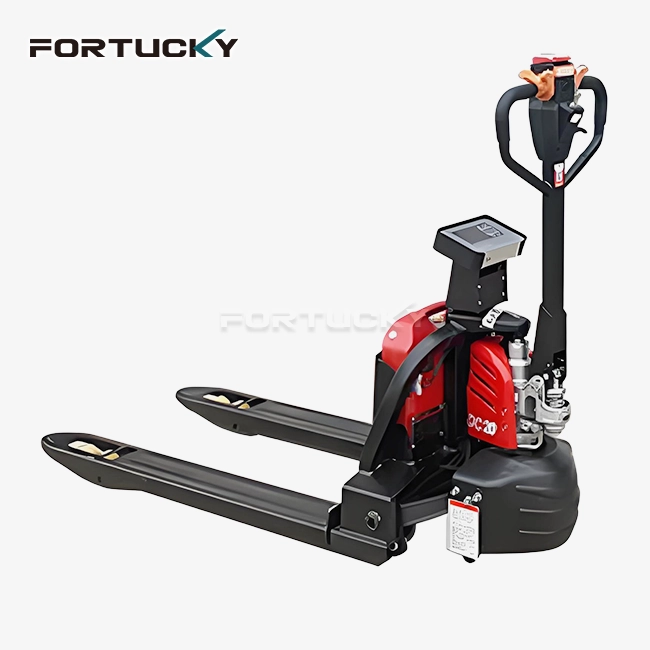
A fully electric pallet jack uses onboard battery-powered electric motors to automate both travel and lifting. Unlike semi-electric models that require manual pushing or pumping, these units perform the entire operation electrically. The operator controls the machine using a comfortable tiller handle with intuitive thumb buttons for direction, speed, and lift. This design requires no physical effort, allowing a single worker to move heavy loads easily across the warehouse floor.
The frames are typically constructed from high manganese steel, which resists deformation even after years of heavy use. Fortucky's models feature plate chain systems and reinforced drive units that maintain structural integrity when moving loads approaching 3000 kg. The dual front wheels provide excellent balance during turns and ensure stability on various floor surfaces.
Core Components and Operational Technology
Modern full electric pallet jacks incorporate intelligent electronic control systems that continuously monitor performance. These systems include fault-reminder features that alert workers to maintenance needs before problems occur, reducing unplanned downtime. Stepless speed regulation allows operators to adjust speed smoothly based on aisle width and traffic levels, improving both safety and usability.
Battery technology has advanced significantly. Larger battery capacities, ranging from 120Ah to 210Ah, enable extended work shifts, with many units operating continuously for eight hours or more on a single charge. The drive motor, typically rated at approximately 1.2 kW, provides sufficient power to climb ramps of up to 10 degrees when fully loaded. Lift motors rated between 2.2 kW and 3 kW enable smooth vertical movement at approximately 90 mm per minute, allowing rapid pallet placement without disturbing the load.
Key Benefits for Material Handling Operations
Using full electric pallet jacks delivers measurable gains across several performance indicators. Workers can move loads at speeds up to 5 km/h without fatigue, significantly increasing productivity. This acceleration is especially valuable in high-volume facilities, where seconds saved per pallet accumulate into hours of additional output each week.
You can't say enough good things about ergonomics. Handles with air springs absorb vibrations and keep your wrists from getting sore after long shifts. Because operators can see over the load better, and because they don't have to pump the air manually, they don't get the repeated motion injuries that are common among people who use traditional equipment.
Full electric pallet jacks shorten dock-to-stock transfer times, boosting throughput. Facilities that switch from manual to full electric pallet jacks typically see material flow speeds increase by 25 to 40 percent. The consistent travel speed, quick lifting response, and tight turning radius (often around 1250 mm) enable workers to navigate narrow aisles and corners that would be challenging for other equipment types.
Comparing Full Electric Pallet Jacks with Alternative Material-Handling Equipment
Manual Versus Motorized: The Performance Gap
Manual pallet jacks can only be used for short distances and light loads because the workers have to turn the handles over and over to lift and move things. Even though the starting costs are cheaper, the hidden costs add up over time because of less work getting done and more injuries. Full electric pallet jacks get rid of these problems because they power both functions, so they can be used continuously over big building areas.
When it comes to horizontal movement, full electric pallet jacks are clearly better than walkie stackers. Stackers have a high reach, but they are slower and harder to move around. The pallet jack design is more efficient and needs less training for operations that focus on moving pallets at ground level instead of high-bay storage.
Advanced Features That Enhance Accuracy
Intelligent chargers built into modern units extend battery life by preventing overcharging and monitoring cell health. This technology increases battery lifespan by 30 to 50 percent compared to basic charging methods, significantly lowering total cost of ownership. Some advanced models include integrated scales that weigh loads during transport, eliminating separate weighing steps and improving inventory accuracy.
The electronic control systems in high-end units can log usage data, identify inefficient routes, and alert managers when maintenance is due. This connectivity supports continuous improvement initiatives and provides operations managers with valuable information for fleet deployment decisions.
Specifications That Matter for B2B Procurement
Load capacity is the most important specification, typically ranging from 2000 kg to 3000 kg for industrial units. Fork lengths from 1150 mm to 1200 mm and adjustable outer widths between 550 mm and 685 mm accommodate standard pallet sizes, offering flexibility for different load types.
The lifting height of 200 mm may seem modest, but this clearance is sufficient for most horizontal movement tasks and maintains equipment stability. Ground clearance of 85 mm allows traversing minor floor imperfections without requiring perfectly smooth surfaces. The choice between polyurethane and nylon wheels affects noise levels, floor protection, and durability based on the operating environment.
 How to Choose the Best Full Electric Pallet Jack for Your Business?
Defining Your Operational Requirements
Warehouse conditions primarily determine equipment needs. Polyurethane wheels are suitable for smooth concrete floors because they operate quietly and protect surfaces. Harder nylon wheels that resist wear and weathering are necessary for rougher concrete or outdoor loading areas.
Power requirements depend on usage intensity. Facilities operating multiple shifts or running 24/7 need 210Ah batteries or opportunity charging methods. Calculating daily pallet moves and average travel distances helps select appropriate batteries without over-specifying.
Load patterns require careful analysis. Consistently moving maximum-weight cartons demands robust lift motors and structural reinforcement. Mixed load handling, by contrast, allows greater flexibility. To prevent equipment stress and extend service life, the recommended capacity should be 15 to 20 percent higher than the average load weight.
Critical Selection Criteria for Long-Term Value
Battery technology affects not only runtime but also maintenance frequency and replacement intervals. Lithium-ion options have higher upfront costs but require no watering, allow opportunity charging during breaks, and offer three to four times the total lifespan of conventional lead-acid batteries. Although lithium is more expensive initially, the total cost of ownership calculation often favors it.
Advanced models include built-in safety features that protect both workers and goods. Anti-rollback systems prevent backward movement on inclines, and creeping speed modes enable precise positioning in tight spaces. Belly buttons that trigger emergency reverse allow operators to quickly move away from pinch points, reducing accident risks in congested areas.
The turning radius of a battery-powered pallet jack changes the minimum aisle width needed and the general economy of the building. Small designs of battery-powered pallet jacks with small turning circles make the most of warehouse space by making the spaces between storage racks more narrow. Figuring out the smallest path width needed for 90-degree and 180-degree turns makes sure that the battery-powered pallet jack fits the plan of the building.
Supplier Evaluation and Support Considerations
Working with established manufacturers provides access to comprehensive after-sales support, which is essential for maintaining uptime. Warranties should cover wear parts and electrical systems in addition to basic defects. Service networks with local presence enable rapid assistance when technical issues arise, minimizing costly downtime.
Fortucky has built a strong reputation by serving more than 1,000 global customers, including major names such as Huawei, Mercedes-Benz, and CATL. This track record demonstrates the ability to handle complex automation projects and integrate new equipment with existing warehouse management systems. The company's competitive R&D team and 5G-enabled smart production facilities ensure that products incorporate the latest technologies while meeting the high reliability standards expected by Fortune 500 clients.
Optimizing Warehouse Operations with Full Electric Pallet Jacks
Identifying and Resolving Workflow Bottlenecks
Inefficient material handling often stems from equipment limitations rather than process design. Receiving areas frequently become congested when manual equipment slows unloading cycles. Replacing manual pallet jacks with full electric models accelerates dock clearance, reducing truck wait times and improving carrier relationships.
Full electric pallet jacks that maintain consistent speed throughout shifts are particularly beneficial for cross-docking operations. Following such upgrades, material transfer time from receiving to shipping is typically reduced by 30 to 45 percent, directly improving inventory turnover and cash flow.
When a mid-sized FMCG distributor switched to full electric pallet jacks, they achieved a 38 percent increase in order fulfillment speed and eliminated two full-time material handling positions. The investment was recovered in 14 months through reduced labor costs and higher throughput, demonstrating the tangible benefits of technology investment.
Maintenance Practices That Maximize Equipment Lifespan
Preventive maintenance plans should include daily user checks of controls, wheels, and battery connections. Weekly inspections of forks and hydraulic fluid levels prevent minor issues from becoming major problems. Monthly professional inspections by qualified technicians identify wear patterns and enable component replacement before failure occurs.
Battery maintenance is the most critical aspect of upkeep. Following proper charging procedures, cleaning terminals regularly, and monitoring charge cycles preserves capacity and avoids premature battery replacement. Facilities with structured battery management programs report battery lifespans 40 to 60 percent longer than operations without formal processes.
Modern equipment features intelligent fault warning systems that alert operators to potential problems in real time. Prompt action on these indicators prevents minor issues from disabling entire machines, maintaining operational continuity and protecting significant capital investments.
Operator Training and Safety Protocols
Comprehensive operator training includes more than just how to use the high-efficiency electric pallet lifter. It also teaches people how to be aware of their surroundings, load things correctly, and handle emergencies. Well-trained operators get the most out of their tools while lowering the chance of accidents and damage to them. It is important for training programs to focus on the unique features of each unit, such as the computer controls and safety systems.
Advanced models include numerous safety features that operators must understand thoroughly. Knowledge of how anti-rollback systems function on inclines, when creeping speed modes activate, and how emergency controls operate ensures that workers respond correctly to unexpected situations. Regular refresher training maintains skill levels and informs operators of equipment changes or updates.
Conclusion
Deploying full electric pallet jacks improves warehouse efficiency by reducing operator fatigue, accelerating cycle times, and increasing throughput. The technology has matured sufficiently to make automation safe and affordable for a wide range of operations. Selecting appropriate specifications based on actual operational requirements, partnering with reliable suppliers who offer comprehensive support, and implementing structured maintenance programs are the keys to maximizing returns on these strategic investments. As labor costs continue rising and customer demands for faster delivery grow, motorized solutions have transitioned from competitive advantages to operational necessities for forward-thinking logistics operations.
FAQ
1. How does battery capacity affect operational flexibility?
Battery capacity directly determines how long equipment can operate between charges. A 120Ah battery typically supports moderate use for 6 to 8 hours, suitable for single-shift operations with scheduled charging. Higher-capacity 210Ah systems enable full-shift operation in demanding multi-shift environments, or opportunity charging during breaks without interrupting work. Lithium-ion batteries accept partial charging without memory effects, offering greater flexibility than conventional lead-acid batteries that require full discharge and recharge cycles.
2. What load capacity should we specify for mixed warehouse operations?
Load capacity selection requires analyzing average pallet weight plus a safety margin. Operations moving loads between 1500 kg and 1800 kg should specify a rated capacity of 2000 kg to avoid strain and maintain performance. Facilities with pallets exceeding 2500 kg require 3000 kg units for safe operation. Over-specifying wastes money on unused capacity, while under-specifying creates safety risks and accelerates wear. Conducting a two-week weight survey of actual loads moved provides data for informed specification decisions.
3. Are financing options available for smaller operations expanding material handling capabilities?
Several financing options accommodate businesses of different sizes. Equipment leasing through third-party lenders requires minimal upfront capital, with payments spread over 36 to 60 months. Some suppliers offer direct financing plans with competitive rates and simplified approval processes. Bulk purchasing across multiple sites may qualify for fleet pricing, reducing per-unit costs by 15 to 25 percent, making expansion more cost-effective for growing businesses.
Partner with Fortucky for Advanced Electric Pallet Jack Solutions
Fortucky is an expert in making automation solutions that work well in harsh industrial settings. Warehouse managers and buying teams that want to improve the efficiency of moving materials can use this knowledge. As a trusted Full Electric Pallet Jack maker, we work with global players in the logistics, electronics, FMCG, and car industries. Our over 1,000 successful projects show that our products work. Our engineering team makes suggestions based on your working needs, the state of the floor, and your output goals. Our localized service network in Asia, Europe, and the Americas ensures quick help wherever your sites are located. Deep customization options make sure that equipment works seamlessly with existing warehouse management systems. Get in touch with our experts at sales@fortuckyrobot.com to talk about your material handling problems and find out how our high-efficiency electric pallet lifts, which come at low prices and can be financed in a variety of ways, can help your warehouse become more productive.
References
1. Frazelle, Edward. World-Class Warehousing and Material Handling, 2nd Edition. McGraw-Hill Education, 2016.
2. Richards, Gwynne. Warehouse Management: A Complete Guide to Improving Efficiency and Minimizing Costs in the Modern Warehouse, 3rd Edition. Kogan Page, 2017.
3. Mulcahy, David E. Materials Handling Handbook. McGraw-Hill Professional, 1999.
4. Tompkins, James A. and White, John A. Facilities Planning, 4th Edition. John Wiley & Sons, 2010.
5. Bartholdi, John J. and Hackman, Steven T. Warehouse & Distribution Science: Release 0.96. The Supply Chain and Logistics Institute, 2014.
6. Lambert, Douglas M. Supply Chain Management: Processes, Partnerships, Performance, 4th Edition. Supply Chain Management Institute, 2014.

Learn about our latest products and discounts through SMS or email