- English
- French
- German
- Portuguese
- Spanish
- Russian
- Japanese
- Korean
- Arabic
- Greek
- German
- Turkish
- Italian
- Danish
- Romanian
- Indonesian
- Czech
- Afrikaans
- Swedish
- Polish
- Basque
- Catalan
- Esperanto
- Hindi
- Lao
- Albanian
- Amharic
- Armenian
- Azerbaijani
- Belarusian
- Bengali
- Bosnian
- Bulgarian
- Cebuano
- Chichewa
- Corsican
- Croatian
- Dutch
- Estonian
- Filipino
- Finnish
- Frisian
- Galician
- Georgian
- Gujarati
- Haitian
- Hausa
- Hawaiian
- Hebrew
- Hmong
- Hungarian
- Icelandic
- Igbo
- Javanese
- Kannada
- Kazakh
- Khmer
- Kurdish
- Kyrgyz
- Latin
- Latvian
- Lithuanian
- Luxembou..
- Macedonian
- Malagasy
- Malay
- Malayalam
- Maltese
- Maori
- Marathi
- Mongolian
- Burmese
- Nepali
- Norwegian
- Pashto
- Persian
- Punjabi
- Serbian
- Sesotho
- Sinhala
- Slovak
- Slovenian
- Somali
- Samoan
- Scots Gaelic
- Shona
- Sindhi
- Sundanese
- Swahili
- Tajik
- Tamil
- Telugu
- Thai
- Ukrainian
- Urdu
- Uzbek
- Vietnamese
- Welsh
- Xhosa
- Yiddish
- Yoruba
- Zulu
What is the maximum travel speed of a battery-powered pallet jack?
Travel speed isn't just a number on a spec sheet when you're looking at material handling equipment for your building; it has a direct effect on how much you can move, how safe the operators are, and how efficiently your business runs overall. The fastest a battery-powered pallet jack can go with all of its weight on board is usually between 4 and 6 km/h (2.5 to 3.7 mph). Advanced Full Electric Pallet Jack types, such as those with large batteries and strong drive motors, can keep going at 5 km/h even when moving 3000 kg loads through busy distribution centers. This speed setting is the best balance between safety and efficiency. It lets workers finish more cycles per shift without sacrificing safety or control.
 Understanding the Maximum Travel Speed of Battery-Powered Pallet Jacks
Figuring out how fast battery-powered pallet jacks can go is important. How fast your team can move things from receiving docks to storage areas or production lines depends on the travel speed. In transportation settings with a lot of goods, even a 1 km/h increase in average trip speed can add dozens of pallet moves per shift.
What Factors Influence Travel Speed Performance?
Several factors determine whether your equipment can maintain top speed. The load weight is the most obvious factor—a pallet jack carrying 2000 kg will perform differently than one carrying 3000 kg. Floor condition matters too. For safety, operators must slow down on cracked surfaces, debris, or hills. Smooth, level concrete is optimal.
Battery charge affects function. The 24V/240Ah battery system powers the 1.2-kilowatt drive motor when completely charged. If the charge decreases below 30%, the speed will slow. Also essential is tire type. Polyurethane wheels grip better and work faster than nylon wheels, especially on polished manufacturing floors.
How Does Speed Compare Across Equipment Categories?
Depending on strength, manual pallet jacks can only move at 2–3 km/h when loaded. Semi-electric models with powered lifting but manual mobility reach similar speeds. Fully electric pallet trucks can move 4–6 km/h, while rider pallet jacks can go above 8 km/h when the operator stands on the platform. Standard counterbalance forklifts are the fastest at 12–18 km/h, but their bulk makes them unsuitable for short storage passageways. Electric pallet equipment is better.
What Makes 5 km/h the Industry Standard?
Job safety research led to the 5 km/h speed limit. At this pace, operators can see everything, respond to anything within a safe stopping distance, and navigate crowded locations safely. OSHA approves this range for foot material handling in mixed-traffic areas where workers and tools share floor space.
Full Electric Pallet Jack Overview: Features and Benefits Related to Speed
Modern electric pallet trucks are made with complex tech that goes far beyond just motors. These machines are well-balanced systems that produce measured output gains by combining power, control, and ergonomics.
Advanced Motor Systems and Speed Control
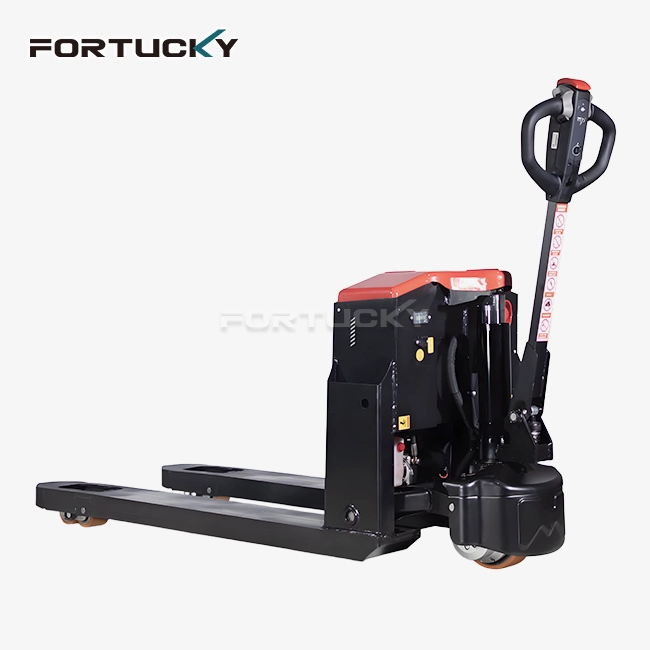
A full-electric hydraulic pallet truck uses high-quality brushless AC drive motors that maintain power across all speeds. The ergonomic handle's thumb controls allow workers to adjust speed with the stepless speed regulation mechanism. Stepless regulation, unlike inferior equipment's jarring on-off switches, permits smooth acceleration from 0 to 5 km/h, reducing product damage and increasing user trust.
The computer control system monitors load, battery, and motor temperature for optimal performance. When the smart controller detects heavy loads or an inclination, it intelligently adjusts power transmission to maintain speeds without overworking the drive system. This smart function prevents mechanical parts from wearing out too soon and ensures machine reliability.
How Speed Enhancements Translate to Operational Benefits
Speed directly reduces cycle time. Imagine a building where workers transport pallets 100 meters at a time. This takes 2 minutes at a 3 km/h manual pace. Electricity at 5 km/h cuts trip time by 40% to 1.2 minutes. This yields large output gains over hundreds of daily changes.
Another benefit is less operator fatigue. Walking behind a manual jack for eight hours requires strength. Electric power makes pushing effortless, so workers can focus on driving and safety. Electric tools help facilities retain more personnel and reduce musculoskeletal pressure injuries, according to research.
Real-World Speed Performance Data
Industrial clients report 25–35% more hourly pallet transfers using motorized pallet jacks. This pharmaceutical distribution center reported that each operator could move 42 pallets per hour with electric tools and 28 with manual jacks. A vehicle parts warehouse discovered that quicker journey speeds benefited long-distance moves between storage sections most.
Comparison of Battery-Powered Pallet Jack Speed With Other Material Handling Equipment
To choose the right tools, you need to know how different types of machines work in different operating situations. Speed is only one factor to think about, but it has a big effect on how well tools work for certain jobs.
Speed Capabilities Across Equipment Types
Workers must push loads on hand-operated pallet jacks, which move at 2–3 km/h. Low-volume enterprises like their low cost and ease of usage, but moving more than 50 pallets per day restricts their efficiency. Walkie pallet jacks with driven drives can reach 4–5 km/h, the same speed as simple electric models but with less complicated control systems.
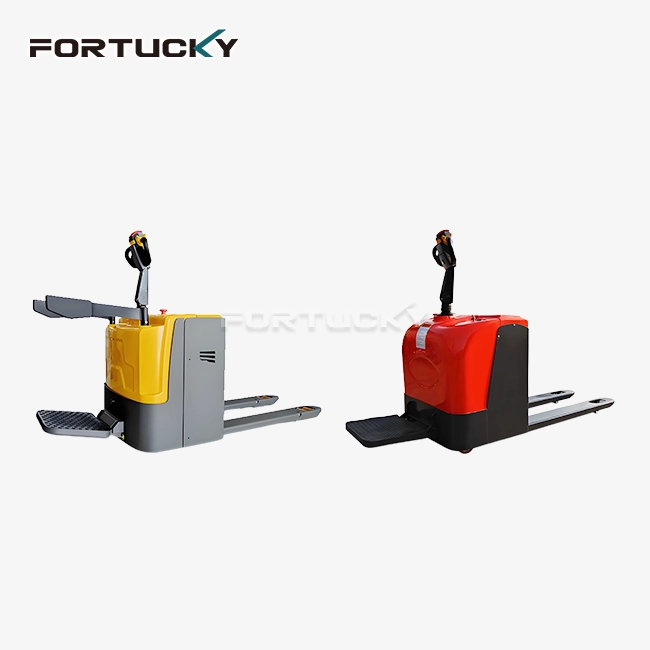
Electric rider pallet trucks, where the driver stands atop the unit, can go 7–9 km/h and are ideal for long-distance transport. They are less helpful for space-constrained situations due to their larger size and higher cost. Counterbalance forklifts go 12–18 km/h and stack vertically. They are complements rather than replacements because they require approved workers, have larger aisles, and cost more.
When Electric Pallet Jacks Offer Competitive Advantages
Electric pallet trucks are ideal for horizontal movement in floor-mounted storage or production buildings. They can turn through regular doors and between rack rows, unlike forklifts, with a 1250 mm radius. Any warehouse worker can learn within hours with minimal training. In comparison, forklift certification takes days of instruction.
Where people and machines move together, electric pallet jack speed patterns work best. At 5 km/h, these devices move purposefully without the safety dangers of quicker equipment in crowded settings. Electric vehicles are quieter than combustion trucks, making the workplace more comfortable.
Understanding When Alternatives Make More Sense
High-storage facilities need forklifts to transport items. Rider pallet trucks' greater speeds may benefit enterprises that move products over 200 meters per trip. Human tools may work in extremely low-volume scenarios with less than 20 boxes per day. Instead of over- or under-specifying your material handling fleet, make sure your equipment's power matches your needs.
Operating and Maintaining Your Battery-Powered Pallet Jack to Achieve Optimal Speed
To get steady maximum speed performance, you need to use the right techniques and follow regular repair procedures. As long as the right care is given to the equipment, it will work reliably for years of heavy use.
Safe Operation at Maximum Travel Speed
Be aware of your surroundings when driving a Full Electric Pallet Jack at full speed. Keep your lines of sight clean and slow down while approaching roadways, pedestrian zones, or blind spots, regardless of your tools. If caught between the unit and something else, the handle's belly button activates the emergency reverse function immediately. This feature can save lives if used correctly.
Load placement affects speed stability. Straighten the pallets on the forks and place the load in the middle of the driving wheels. Unbalanced loads make steering difficult and increase tipping risk, especially when turning. Approach hills straight on, not at an angle. Remember that the 10° climbing ability only works for equally distributed weights on dry, clean surfaces; damp or oily surfaces require slower climbing.
Battery Care for Sustained Speed Performance
These machines demand careful management of their 120Ah to 210Ah batteries. Unlike lead-acid batteries, lithium-ion batteries, which are becoming more widespread in modern tools, may be charged throughout shifts without losing charge. Charge control helps them, though. Good equipment's smart charger analyzes cell health and changes charging settings on its own, but users must keep connections clean and safe.
Battery health determines power availability. Batteries slowly lose capacity after 1000 charges. Motors get less constant power. Loaded cars have slower top speeds, especially at shift ends. Battery maintenance plans based on performance testing rather than random dates and hours improve equipment capabilities and business budgets.
Mechanical Maintenance for Speed Consistency
Checking drive wheels regularly maintains performance. Without missing sections or flat patches, polyurethane wheels should wear evenly. The 250x80 mm rolling wheels carry big loads, and uneven wear causes vibrations that require users to slow down for comfort and control. Wheel replacement is a simple repair that improves vehicle performance.
The plate chain drive system that transfers motor power to the wheels needs regular tightening. Loose chains leave the engine slack, making acceleration abrupt and power transmission inefficient. Drive unit durability is due to high manganese steel. Moving parts last longer if they're lubricated according to the manufacturer's directions.
 How to Choose the Right Battery-Powered Pallet Jack Based on Speed and Other Criteria?
Choosing what to buy has long-term effects that go far beyond the original cost of the item. The total cost of ownership is lower when you choose tools that really meet your business needs instead of just looking at how much it costs to buy.
Aligning Speed Requirements With Operational Demands
Before choosing tools, you should look at how your current process works. Facilities with small plans where people usually move 20 to 50 meters don't benefit much from equipment going faster than 5 km/h because workers spend more time positioning than moving. On the other hand, distribution centers with shipping and receiving places that are 100 meters or more apart gain a lot from higher sustained speeds.
When looking at speed needs, cycle time goals should be taken into account. Figure out how fast you need to move to meet your goals by calculating how many pallets you need to move each hour and adding in the time it takes to set up and record the information. Adding a small amount of extra capacity (10–15% above the baseline needs) can handle changes in demand without pushing equipment past its best operating range.
Balancing Load Capacity With Performance Specifications
It might not seem important that rated limits of 2000 kg vs. 3000 kg differ, but they do affect many aspects of performance. Lifting motors in heavier-duty types are 3 kW, which are more powerful than the 2.2 kW motors in lighter-duty tools. Not only does this extra power change the pulling speed (which stays at 90 mm/min), but it also changes how fast the system is and how long it lasts when it's regularly working close to its limits
The size of the fork is important. The 1150 mm forks that come with 2000 kg models are big enough to handle most North American box sizes (48×40 inches), and the 1200 mm forks that come with 3000 kg models make it easier to move loads that are too big or don't fit properly. Fork outer width choices (550 mm vs. 685 mm) determine how well the forks work with special pallet designs that are popular in some industries, like chemical handling or distributing drinks.
Evaluating Total Cost of Ownership Beyond Purchase Price
Energy efficiency has a big effect on how much it costs to run tools over its whole life. Quality battery systems have an 8-hour standard usage time, which means that single-shift operations rarely need to be charged in the middle of the shift. This simplifies the electricity infrastructure needs of the facility. Models with regenerative brakes, which return energy when the vehicle slows down, have longer battery life between charges and use less power each year.
Long-term prices are greatly affected by how easy it is to do maintenance. Technicians can do regular maintenance faster when the equipment is made with modular parts and clear entry panels. The smart electronic control system with fault warning features allows for predictive maintenance by letting workers know about problems as they arise, before they become major issues. This keeps unexpected downtime costs to a minimum.
Procurement Considerations for B2B Buyers
An electric ride-on pallet truck from different sellers comes with very different warranty terms. Standard coverage for electrical parts and drive systems lasts for 12 months, but top makers extend this to 24 to 36 months, which shows that they are confident in the quality of the build. Make it clear what is covered by the guarantee. Normal wear and tear, things like wheels and forks, are generally not covered by warranties, but breakdowns of the motor or controller should be.
Vendor help skills are very important for keeping service. When repair is needed, suppliers with localized service networks can handle it faster than those who rely on centralized facilities that are far away. When looking at possible vendors, get recommendations from customers in related industries and make sure parts are available. Common parts should ship within 24 to 48 hours to keep equipment running as much as possible while they are being fixed.
Conclusion
Knowing the fastest speed at which something can move helps you choose material handling tools that will really work for your business. Quality full electric pallet jacks can move at a standard speed of 5 km/h, which is the best mix between safety and efficiency for most warehouse tasks. Speed is important, but it's part of a bigger picture that includes things like load ability, battery life, build quality, and manufacturer support. Facilities that carefully look at their real process needs and choose equipment with the right specs always get a better return on their investment than those that try to meet the highest specifications without a good reason. When you combine a reliable 5 km/h travel speed with strong construction and smart control systems, you get measured improvements in storage efficiency while also making sure operators are safe and comfortable during long shifts.
FAQ
Q1: What is the safest maximum speed for busy warehouse environments?
5 km/h is the safest speed for operating in stores with mixed traffic, where people and machines share the floor space. Regulatory advice says that this speed gives enough time to respond to avoid obstacles while keeping output high. In places with a lot of foot traffic, people should be able to choose to slow down, even if their tools can't.
Q2: How significantly does a full load impact travel speed?
When they are fully loaded, good full electric pallet jacks keep going at their stated top speeds. A well-kept unit with a fully charged battery should be able to reach 5 km/h, whether it's carrying 2000 kg or 3000 kg. When there is a load, noticeable speed drops usually mean that the battery is dying, the machine is wearing out and needs to be fixed, or the machine is being used past its stated capacity limits.
Q3: Can I upgrade or modify my pallet jack for higher speeds?
When manufacturers set speed limits, they do a lot of safety tests to make sure the cars can stop, stay stable, and have strong structures. Aftermarket changes that try to increase the top speed cancel warranties and leave you open to a lot of risk. If you need equipment that works at higher speeds, you should buy machinery that is rated correctly instead of making changes to current assets that go beyond what was designed.
Partner With Fortucky for Your Electric Material Handling Solutions
Buying a Full Electric Pallet Jack from the right company can turn a simple piece of equipment into a big advantage for your business. Fortucky has more than ten years of experience in clever logistics automation. He has provided unique material handling solutions to more than 1,000 clients around the world, including Huawei, Mercedes-Benz, and CATL, which are all leaders in their fields. Our engineering team creates pallet jack systems with travel speeds that work best for your facility's plan. These systems combine proven 5 km/h performance with enterprise-grade durability, thanks to their high manganese steel construction and smart computer controls. We can make a lot of changes to meet the specific needs of your business, such as customizing the fork setups or integrating them with your current warehouse management systems. Our localized service network across North America guarantees quick responses, and our competitive production efficiency saves you a lot of money without sacrificing quality. Contact our team at sales@fortuckyrobot.com to talk about how our Full Electric Pallet Jack solutions can help your facility's throughput.
References
1. Industrial Truck Association. (2021). "Safety Standards for Low Lift and High Lift Trucks: ANSI/ITSDF B56.1-2020." ITA Technical Publications.
2. Materials Handling Institute. (2022). "Electric Pallet Jack Performance Benchmarking Study: Speed, Capacity, and Efficiency Metrics." MHI Industry Report Series.
3. Occupational Safety and Health Administration. (2020). "Powered Industrial Trucks: Operator Training and Safe Operation Guidelines." OSHA Publication 3328.
4. Modern Materials Handling. (2023). "Total Cost of Ownership Analysis for Battery-Powered Material Handling Equipment." Peerless Media, LLC.
5. International Warehouse Logistics Association. (2022). "Best Practices for Electric Pallet Jack Selection and Fleet Management." IWLA Technical White Paper.
6. Society of Automotive Engineers. (2021). "SAE J2891: Electric Battery-Powered Industrial Trucks - Performance and Safety Requirements." SAE International Standards.
Learn about our latest products and discounts through SMS or email