- English
- French
- German
- Portuguese
- Spanish
- Russian
- Japanese
- Korean
- Arabic
- Greek
- German
- Turkish
- Italian
- Danish
- Romanian
- Indonesian
- Czech
- Afrikaans
- Swedish
- Polish
- Basque
- Catalan
- Esperanto
- Hindi
- Lao
- Albanian
- Amharic
- Armenian
- Azerbaijani
- Belarusian
- Bengali
- Bosnian
- Bulgarian
- Cebuano
- Chichewa
- Corsican
- Croatian
- Dutch
- Estonian
- Filipino
- Finnish
- Frisian
- Galician
- Georgian
- Gujarati
- Haitian
- Hausa
- Hawaiian
- Hebrew
- Hmong
- Hungarian
- Icelandic
- Igbo
- Javanese
- Kannada
- Kazakh
- Khmer
- Kurdish
- Kyrgyz
- Latin
- Latvian
- Lithuanian
- Luxembou..
- Macedonian
- Malagasy
- Malay
- Malayalam
- Maltese
- Maori
- Marathi
- Mongolian
- Burmese
- Nepali
- Norwegian
- Pashto
- Persian
- Punjabi
- Serbian
- Sesotho
- Sinhala
- Slovak
- Slovenian
- Somali
- Samoan
- Scots Gaelic
- Shona
- Sindhi
- Sundanese
- Swahili
- Tajik
- Tamil
- Telugu
- Thai
- Ukrainian
- Urdu
- Uzbek
- Vietnamese
- Welsh
- Xhosa
- Yiddish
- Yoruba
- Zulu
Your Guide to Push-Back (High-Density) Pallet Racking
When warehouse space becomes your most precious commodity, push-back storage racks emerge as a transformative solution. This high-density system revolutionizes how medium to large enterprises store inventory, delivering up to 90% more capacity than traditional selective racking. By eliminating unnecessary aisles and enabling multi-pallet depth storage, these systems address the critical challenge facing logistics managers today: doing more with less square footage while maintaining operational efficiency and safety standards.
 Understanding Push Back Racking Systems
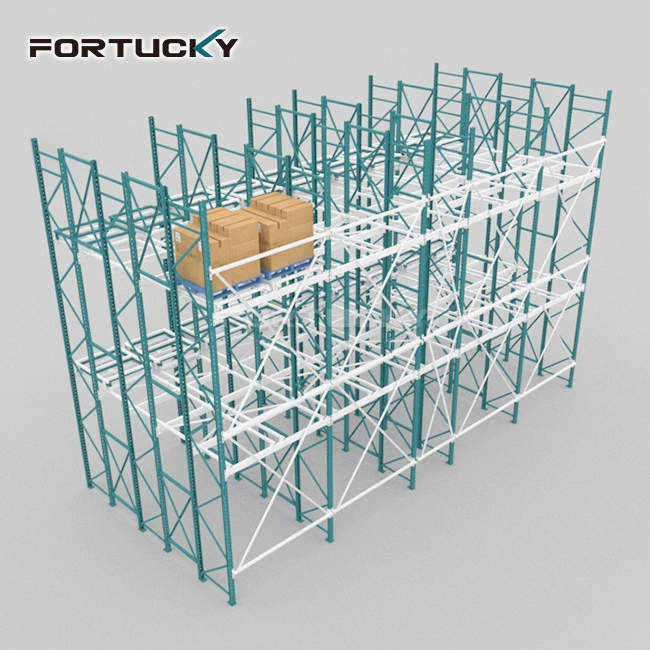
Push-back racking represents a significant advancement in warehouse storage technology. Unlike conventional systems that require multiple access aisles, this design compresses storage into narrow lanes where pallets rest on nested carts that run along inclined tracks. The system works seamlessly: adding a new pallet moves existing items further back into the lane, and removing one triggers automatic forward movement through gravity-assisted flow.
Major manufacturers, including Mercedes-Benz and CATL, rely on similar high-density systems that maximize both vertical and horizontal space. The system can hold 2 to 6 pallets deep per lane, making it highly versatile for businesses that need to store large quantities of the same SKU. Each lane operates independently, so different products can be stored in separate locations without cross-contamination or access difficulties.
Heavy-duty steel frames form the structural backbone. Each pallet position can support more than 4,000 pounds. Descent speed is controlled by damping devices, which prevent the sharp impacts that damage goods in less advanced systems. This controlled movement extends product life and reduces insurance claims for damage.
How Push Back Storage Works
The operational brilliance lies in simplicity. Inclined rails create a gravitational advantage, where loaded carts naturally migrate toward the pick face when front positions are empty. Forklift operators engage only at lane entrances, eliminating the risky maneuvers required in drive-in configurations. This single-sided access model transforms workflow efficiency.
Consider a beverage distributor managing seasonal inventory surges. As pallets arrive, operators push them sequentially into available depth positions. The last pallet loaded becomes the first retrieved—a first-in, last-out (FILO) storage system ideal for products with predictable rotation patterns. When the front pallet is removed, spring-loaded or gravity-fed carts advance to the next position automatically.
Temperature-controlled environments benefit tremendously from this design. Cold chain operators in the pharmaceutical and food processing sectors reduce refrigeration costs by minimizing the aisle space that requires climate control. A dairy processor storing products under stringent temperature requirements could consolidate its cooler footprint by 40% compared to selective racking alternatives.
The cart system requires no electrical components or complex automation, yet delivers semi-automated functionality. Maintenance demands remain minimal—periodic rail inspections and occasional cart bearing replacements constitute the full service schedule. This mechanical simplicity translates to decades of reliable operation without software updates or technical obsolescence.
Key Advantages for Manufacturing and Logistics Operations
Space optimization transforms cost structures across entire operations. Automotive parts suppliers supporting BMW or FAW Hongqi production lines face constant pressure to reduce warehousing overhead while expanding SKU variety. High-density push-back racks convert previously wasted aisle space into revenue-generating storage capacity, often recovering initial investment within 18-24 months through reduced lease obligations alone.
Operational speed accelerates noticeably. Forklift operators complete put-away and retrieval tasks 30–50% faster when they eliminate deep-aisle navigation. FMCG distributors report throughput improvements that allow servicing more retail accounts without fleet expansion. Driver fatigue decreases when movements become more predictable and confined to shorter distances.
Safety metrics improve dramatically compared to drive-in alternatives. Collision risks plummet when forklifts never enter storage lanes. Steel and heavy industry operators—where warehouse accidents carry catastrophic potential—appreciate how push-back shelving isolates powered equipment from stored goods. Insurance premiums often reflect this reduced risk profile, delivering ongoing savings beyond operational benefits.
Integration capabilities matter profoundly for digital transformation initiatives. Modern push-back rack systems interface seamlessly with warehouse management systems (WMS) and warehouse control systems (WCS). Electronics manufacturers implementing Industry 4.0 strategies can track inventory movement through RFID-enabled cart positions, creating real-time visibility that feeds production planning algorithms and just-in-time fulfillment protocols.
Ideal Applications Across Industries
Cold chain logistics finds its perfect match in push-back pallet racks. Refrigerated and frozen storage facilities maximize expensive climate-controlled cubic footage while maintaining product accessibility. Agricultural processors handling perishable goods achieve density ratios unattainable through conventional methods, preserving margins in notoriously thin-profit sectors.
New energy battery production—a cornerstone for companies like BYD—demands specialized material handling for heavy, high-value components. Push-back rack capacity handles substantial weight loads while organizing semi-finished goods flowing through complex assembly sequences. The FILO characteristic aligns naturally with production batch flows, reducing inventory confusion during rapid scaling phases.
Pharmaceutical and chemical operations benefit from the SKU separation each lane provides. Regulatory compliance becomes manageable when different compounds occupy distinct lanes with clear identification. The closed-front design minimizes contamination risks compared to open selective systems, addressing quality control concerns that keep compliance officers awake at night.
Construction machinery suppliers stocking bulky replacement parts with irregular demand patterns also benefit. The system's flexibility accommodates varying pallet dimensions within the same framework through adjustable beam heights, adapting to inventory mix changes without infrastructure overhauls.
Design Considerations and Customization Options
Determining optimal configuration starts with SKU velocity analysis. Products moving fewer than 10 times annually but stored in multi-pallet quantities represent ideal candidates for first-in-last-out (FILO) storage systems. Lane depth selection balances storage density against inventory turnover requirements—deeper lanes maximize space but potentially increase average retrieval complexity for mixed-age stock.
Structural customization addresses facility constraints. Ceiling heights dictate vertical scaling opportunities, with systems engineered up to 10 meters to accommodate low-clearance buildings or maximize clear-span warehouses. Color-coding options assist warehouse teams in visual management programs, where different color schemes designate product families or quality status.
Load capacity specifications must account for peak weight scenarios plus safety margins. Heavy industry applications storing steel components or industrial equipment demand engineering calculations that consider dynamic loading, seismic requirements, and long-term structural fatigue. Reputable manufacturers provide certified load testing documentation, essential for regulatory approvals and liability protection.
Integration with existing infrastructure influences design decisions. Facilities transitioning from selective racking can often repurpose floor space without major concrete work, though seismic anchoring must meet current codes. Conveyor interfaces enable automated replenishment from production lines, creating hybrid manual-automated workflows that optimize labor deployment.
 Comparing Push Back Systems to Alternative Solutions
Against selective racking, push-back designs sacrifice single-pallet selectivity for density gains. Operations requiring access to every individual pallet at any moment should maintain selective systems. However, most manufacturing and logistics operations store inventory in homogeneous batches where FILO rotation poses no operational penalty, making the capacity trade-off highly favorable.
Drive-in racking offers similar density but introduces significant safety and efficiency compromises. Forklift operators navigating narrow interior lanes face elevated accident risks and slower cycle times. Structural damage from vehicle contact accumulates faster, increasing maintenance costs. Push-back rack safety profiles prove superior across every measurable metric while delivering comparable storage density.
Automated storage and retrieval systems (ASRS) provide higher throughput but demand substantially greater capital investment and ongoing technical support. Mid-sized manufacturers pursuing automation readiness find push-back systems bridge the gap—delivering semi-automated flow at a fraction of ASRS costs. The solution scales naturally as operations mature, with add-on automation possibilities preserving initial investments.
Pallet flow racks enable true FIFO (first-in, first-out) rotation through rear loading and front retrieval. Perishable goods requiring strict date rotation benefit from this design. Push-back rack efficiency shines when FILO rotation suffices, eliminating the need for rear access aisles and their associated space consumption. Matching system characteristics to actual operational requirements prevents over-engineering expenses.
Installation and Maintenance Best Practices
Professional installation ensures structural integrity and operational safety for push-back storage racks. Certified installers verify floor load capacities, implement proper anchoring techniques, and calibrate rail angles for optimal cart flow rates. Attempting self-installation risks safety violations and warranty voidance, exposing operations to liability that dwarfs professional service costs.
Initial setup includes operator training on proper loading techniques. Centered pallet placement prevents binding as carts travel on the rails. Weight distribution awareness prevents single-sided overloading that stresses frames asymmetrically. Well-trained teams extract maximum system lifespan while maintaining safety standards that protect both personnel and inventory.
Routine inspections follow predictable schedules. Monthly visual checks identify bent rails, damaged carts, or compromised damping mechanisms before failures occur. Annual professional assessments by qualified engineers catch structural concerns invisible to untrained observers. Documentation of these inspections satisfies insurance requirements and demonstrates due diligence during incident investigations.
Cart maintenance focuses on bearing function and wheel integrity. Replacing worn components before failure prevents sudden drops that damage goods or injure personnel. Keeping rails clean from debris ensures smooth movement—particularly critical in dusty environments such as construction machinery warehouses or agricultural processing facilities. Preventive maintenance costs represent a fraction of reactive repair expenses following catastrophic failures.
Conclusion
High-density push-back racks address the fundamental challenge facing modern logistics operations: extracting maximum value from constrained warehouse space. By eliminating excess aisles, automating pallet flow, and maintaining safe access protocols, these systems deliver measurable improvements in storage capacity, operational speed, and cost efficiency. Manufacturing and logistics leaders across FMCG, automotive, electronics, and cold chain sectors continue adopting this proven technology as facilities modernize. When evaluating warehouse optimization strategies, push-back storage systems deserve serious consideration as foundational infrastructure supporting long-term competitiveness in increasingly demanding supply chain environments.
Transform Your Warehouse Efficiency with Fortucky's Push Back Storage Solutions
Fortucky brings three decades of intelligent warehousing expertise to push-back storage racks design and implementation. As a trusted manufacturer serving over 1,000 global enterprises—including Huawei, COFCO Group, and Aviation Industry Corporation of China—we deliver customized high-density systems engineered for your specific operational requirements. Our 5G-enabled production facilities ensure rapid delivery, while localized service teams across Asia, Europe, and the Americas provide responsive support throughout your system's lifecycle. Contact our specialists at sales@fortuckyrobot.com to schedule a consultation and discover how our cost-effective push-back storage racks maximize your warehousing ROI.
References
1. Richards, Gwynne. Warehouse Management: A Complete Guide to Improving Efficiency and Minimizing Costs in the Modern Warehouse. 3rd edition. Kogan Page Publishers, 2017.
2. Bartholdi, John J. and Hackman, Steven T. Warehouse & Distribution Science: Release 0.98. Supply Chain and Logistics Institute, Georgia Institute of Technology, 2019.
3. Frazelle, Edward. World-Class Warehousing and Material Handling. 2nd edition. McGraw-Hill Education, 2016.
4. Mulcahy, David E. Materials Handling Handbook. McGraw-Hill Professional, 1999.
5. Tompkins, James A. et al. Facilities Planning. 4th edition. John Wiley & Sons, 2010.
6. Berg, Jeroen P. van den and Zijm, Henk. Models for Warehouse Management: Classification and Examples. International Journal of Production Economics, Vol. 59, 1999.

Learn about our latest products and discounts through SMS or email